While brake lights are a fine and necessary signal, I find myself wishing that cars would display speed & acceleration deltas compared to the vehicle in front. Brake lights do not convey how much deceleration is occurring, so it's not immediately obvious how much time there is to impact.
As an example, I see lots of drivers do minor braking on US highways, where their small braking corrections will cause their tail lights to flash for a brief moment. These minor corrections become noise that drowns out the signal of significant, safety-related braking. If my vehicle could warn me that their rate of deceleration puts our vehicles on a collision course... now that would be very useful.
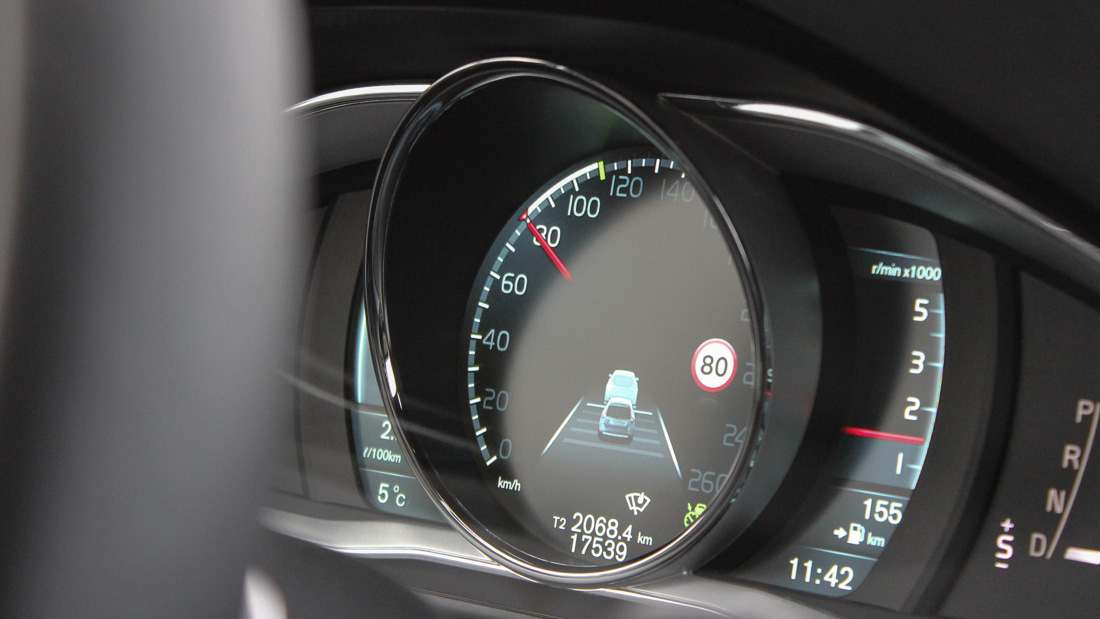
Some do: In ACC mode my 2013 Volvo uses radar to "lock" on the car in front of me. If it is slower than the ACC set point, its speed is indicated in the instrument panel.
It looks like this: https://www.motoreport.de/wp-content/uploads/2014/01/IMG_296...
Set point is 110 km/h (green marker), the car in front is going 80 km/h (solid white line indicates the speed difference). The small red triangle indicates the speed limit of 80 km/h. Obviously the ACC is also cruising at 80 km/h, so most indicators are focused there.
And you're right, even with the limited form (single car in front of me on the same lane, data only shown if slower) this is amazing.
> According to DEA's data, manufacturers have not fully utilized the APQ for amphetamine in support of domestic manufacturing, reserve stocks, and export requirements for the past three calendar years 2020, 2021 and 2022.
> Based on this trend, DEA has not implemented an increase to the APQ for amphetamine at this time.
Which suggests that the DEA's quota for adderall is not (yet) to blame.
> The majority of the manufacturers contacted by DEA and/or FDA have responded that they currently have sufficient quota to meet their contracted production quantities for legitimate patient medical needs.
“The majority” “legitimate patient medical needs” sounds like a bunch of trippy legalese. If it’s the majority of the manufacturers they contacted, doesn’t that mean that there’s at least one that has exhausted their production? Could that one perhaps be the largest one, like Teva?
If that’s the case, then yes, there could be a shortage. And they’re not increasing it because there’s been a surge of “illegitimate” shops that have popped up and prescribed remotely since Covid that the DEA is investigating and/or shutting down.
And that may not even be the real reason. Could be the understaffing issues quoted in august. Either way, that answer from the register is a non-answer.
> If it’s the majority of the manufacturers they contacted, doesn’t that mean that there’s at least one that has exhausted their production? Could that one perhaps be the largest one, like Teva?
Also, if any one doesn’t have enough, that increases the amount needed for legitimate patient needs for all the others: either (1) they all have enough for legitimate patient needs, or (2) none of them do.
And, here’s the thing, if there are patients with prescriptions who aren’t able to get them, or are having to scramble to call around to different pharmacy chains with different contracted suppliers to find one that isn’t out and unable to restock the particular dosage capsule (because they aren’t fungible) of the particular drug they are prescribed, then, no, there aren’t enough for legitimate patient needs.
“But some prescriptions are illegitimate” – maybe, but supply constraints don’t fix that or target illegitimate prescriptions, they just make it (well, until all supply is exhausted, then everyone is SOL) a lottery for every patient, regardless of legitimacy of their prescription. It adds a whole new problem, rather than solving the notionally motivating problem, and it is so obvious that this is the case that either the people adopting the policy are the biggest fucking idiots in the world, or the policy is outright malicious and not directed at the problem that supposedly justifies it. (Since its part of the War on Drugs, the second option is guaranteed to be part of it.)
>Could that one perhaps be the largest one, like Teva?
maybe, but from my experience with governmental writing it probably means that there are a bunch of companies and some smaller companies they don't want to point out for some reason have exhausted production. If it was the largest company exhausted I would expect it to say something like
"although the majority of smaller companies still have not exhausted their productive capabilities, the larger suppliers report that they cannot produce more at this time"
Also - I would generally expect that largest suppliers exhaust their capabilities after the smaller suppliers exhaust theirs - although I guess some supply chain studies probably exist that would say if my expectation is off.
It seems, simply put, that more people are choosing to live alone in this market. If that holds true, then it could explain the large surge in demand in recent years. Perhaps it's not that the market lacks enough housing for people, it's that the market lacks enough housing for the number of people who wish to live alone.
For reference, 16.7% of adults aged 18-25 and 55.1% of adults ages 25-34 are living with a spouse or other partner as of 2018, down from 39.3% and 81.7% respectively in 1970. By my math that alone is responsible for an increase in demand of close to 10 million housing units. https://www.census.gov/library/stories/2018/11/cohabitation-...
Of course, young adults living with roommates or parents have absorbed some of that difference, but I'm sure many of those people would live alone if housing prices were still at 1970 levels.
272 days is very high. Full time work in the US with 0 vacation (typically is 10-20 days) and 0 company holidays (typically is 5-15 days) is 250 days. Perhaps you mistyped?
Some stores, like Costco, have an interesting, alternative approach. Many items in their electronics department are prepay. You can try out the floor model (tethered to the display platform), and if you wish to purchase it you pull a cardboard item card. That card is scanned during the checkout process, and once payment is received, the staff bring the physical item from secure storage to the post-paid customer.
With the item card approach, you never have the product in your hands until it has been paid for. Between that practice and their receipt checking at the exit, I do wonder what their theft numbers look like.
Around here in <some European country>, they do this quite often with stuff that tends to get stolen (video games and such) and stuff that they must not sell to children (like razor blades).
You just get a bit of cardboard from the aisle, and either the cashier gives you the item when you pay, or you retrieve it from a counter, showing the receipt.
It’s actually quite mind-boggling that their conclusion from their risk analysis is to get this high-tech solution with potentially much worse user experience, than the foolproof low-tech one that just involves them paying one more bloke.
It's not just paying the person to get your product after you pay for it; they also need to rearrange their space to store those things (many which are bulky) towards the front of the store. Locked cases are an in between step, need a person to help, but don't need a dedicated space at the front.
Fair enough, this needs to be taken into account in the stock management.
That said, for bulky items there is either someone bringing them over, or a counter closer to where the stuff is stored (often in another building). They don't keep stuff like piles of large TVs at the front of the store.
Had the same experience buying a CPU from Microcenter. You told a store associate what processor you wanted, he wrote it on a cardboard slip, then you get the product after checkout is paid for. Overall I was pretty happy with the process. Hardest part was hunting down a sales associate.
I've never been to Costco, but Toys R Us used to have their video games like that in the 80s. We also had a chain of stores around here called Best, that I seem to recall having a conveyor belt of whatever you bought, and you would stand there with your receipt waiting for it to come out. I may have imagined that though. Either way, it would be much more effective at stopping theft.
As we transition to more pickup/delivery-type retail that will happen more and more. Expect to see the "counter" move forward toward the front of the store as grocery and retail return to the "general store" type aesthetic, where most of the stock is behind the counter instead of in front of it.
Will also eventually save on packaging too, as it won't have to be flashy.
One thing to keep in mind is the non-monetary side of taxes: they are used to influence behavior. Offering employee benefits (healthcare, retirement, etc.) is incentivized by US tax code thus influencing more companies to do so.
I'm not saying that corporate behavior becomes uninfluencable when profit taxation is removed, but rather that it will require a different incentive mechanism. That is assuming that we still want to influence corporate behavior through government without legislating it.
That is close, but not quite correct. You can gift <= $15000 per year without reporting it. You can gift > $15000 federal tax-free (state tax may apply), but must report it. Reporting it doesn't incur federal taxes until your lifetime gift total exceeds your lifetime gift exclusion of $11,700,000 (2021).
You can gift $15,000 per person, per year, without counting against the exemption. If you go above that you start to chip into the massive lifetime exemption.
Unless you have a net worth way above $10 million dollars you don't need to worry about the gift tax. If you accidentally forgot to report a $30,000 "loan" that turns into a gift to a friend, the IRS isn't going to care. You might have to go back and fix it if they notice but it isn't going to be a problem.
The gift tax exists to prevent extremely rich people from cheating the estate tax. If you've never heard of the gift tax before you don't need to worry about.
I heartily recommend proper winter boots for anyone that is worried about slipping. Not all boots are created equally, but the tread and rubber compound used for most winter boots can make a dramatic difference in grip while walking.
For those who have never owned transportation in a cold climate: winter tires on vehicles make a big difference in traction. They channel and grip to snow and ice much better than the tread and rubber compound of a standard all-season tire. The same concept applies for winter footwear.
No boot will help you over smooth ice, sorry. You can wear something like Yaktrax, over your shoes, or look out for a thin layer of ice on the pavement.