For the vast majority of projects it seems like the disadvantages of these highly complex RPC systems far exceed the benefits... Not just in terms of security but also the reduced observability compared to simple JSON..
The creators of Maa Ka Doodh, a famous documentary about the dairy industry in India have alleged that their channel has been deleted under false pretenses. [1]
Does YouTube really delete channels globally, even at a government's request?
No and it never has. The default position on the internet, the one technologists working on open source always took, is that only the ideas matter and if your ideas are good you'll be included. DEI became popular because that wasn't good enough for certain groups of people who consistently failed to produce good ideas and wanted to wedge themselves in anyway.
Yeah, from a non-US citizen views, this type of policy feel like target discrimination against certain groups of individuals.
And the message sent is disastrous. Personally I am part of people who have big advantages with actual DEI policy, but I am firmly against that, because I want to be employed for my skills, not because I fit a quota or anything like that.
> this type of policy feel like target discrimination against certain groups of individuals.
Every policy is targeted discrimination for or against certain groups of individuals (and you can invert the group and make the same policy switch from "for" to "against".)
> Every policy is targeted discrimination for or against certain groups of individuals
Lol are you talking about "discrimination" on the basis of task-relevant skills?
Until 20 years ago, nobody in OS cared who you were IRL, your gender, ethnicity etc. In many cases they didn't even know, plenty people only contributed under pseudonyms. Hard to believe for people who only joined the show after social media had become pretty much mandatory, and the "I don't care who you are IRL"-crowd got drowned out by "who you are IRL is the most important thing, not what you contribute"-crowd.
I think their point is that there was never any reason to even know what people identify as, or your political views, and that there still shouldn't be. That things like "diversity" in online-only circles doesn't really make sense. I don't want to know your sexual preferences or your gender identity, not that I am against anything, just that it's completely irrelevant to writing code and learning about technology etc. and only seems to lead to more drama by including it at all.
As a more personal example, I no longer support the Linux kernel because I no longer consider it fully "open" to contributions, especially when accepting those contributions are no longer based solely on technical merit, but are also actively rejected for political reasons, even for patches that are merely fixes, which benefits everyone, and not just a sanctioned country. Even going so far as removing names from the maintainers list because of some unspoken combination of their country of origin, employer or political affiliation. Not only the lack of advance notice, transparency and empathy, but the abusive attitude Linus continues to display to the world about this and many other issues.
Back then my field had plenty women and asians, I also knew a bunch of middle easterners (mostly iranians, but that's probably by accident). They got into the field because they were interested in it, so they were good at it!
Nowadays many people (including the despised white boys) enter the field because they think it's an easy way to make money, not because they're interested in it. But at least with the white boys, employers are still allowed to filter based on interest and ability. They can't filter out "oppressed identity havers" on the basis of interest or ability, who as a result are just as bad as nepotism hires -- some are good, most aren't.
What we should have focused on for the last 20 years was reducing nepotism, instead we created a new type of nepotism based on identity. In traditional nepotism you need an uncle who is friends with the boss, here you just need the skin color that is friends the boss of your (boss's)^n boss.
> I think we need diversity. Am I wrong?
There are definitely some circumstances where identity and cultural background can be very job-relevant -- for example for understanding your customers.
But that's pretty limited. Does your skin color or genitals have an effect on what kind of networking problems you can solve? The only reason we haven't proven the Riemann hypothesis yet is because we forgot to hire a Manchu-Bantu queer Muslim with ovotesticular syndrome and vitiligo? I don't think so.
Even if you believe that, this perceived need does not justify identity-based discrimination. Discrimination creates resentment.
Actual, legally enforced, culturally glorified discrimination (which corporate america currently has against white and asian men, unless they're nepotism hires) creates more resentment than does the ethereal, unfalsifiable, hypothetical discrimination that you assume to exist based on outcome disparities, even though companies are aggressively punished for any actual such discrimination (against anyone besides white and asian men).
The main unfairness in corporate America is nepotism. If you fight that, you'll automatically fight more white men than members of other identity groups. The main unfairness in America in general is poverty. If you fight poverty you'll automatically help more minorities. The main beneficiaries of DEI are "oppressed identity havers" from high income backgrounds. DEI reinforces/extends nepotism and income inequality instead of fighting it.
> The main unfairness in corporate America is nepotism. If you fight that, you'll automatically fight more white men than members of other identity groups.
adolph reed says something similar to this as well.
one important addition to that conversation is that what dei (in many cases) represents is the implicit acceptance of the system as-it-is except that the only problem remaining is 'equal representation'
so if (going to extremes) you have a corrupt organization, just making the identify of that organization represent the makeup of society doesn't fix that corruption; it just makes it look more legitimate...
I haven’t remembered any policy like that in past decades, for my country even more ( in the US you have to go back to apartheid to find policy who are discriminated against group of people)
And in context of work or anything like that, the only policy who actively discriminate is the skill, and I don’t place this in the same level of DEI because you can acquire more skill, but you cannot change your color skin or origin for example.
reading too deeply into it, it's basically an interjection. it doesn't refer to any meaningful facet of objective reality, it only exists according to the socio-political hallucinations of americans. doesn't matter if it's said positively or negatively, it's just a virtue signal long devoid of meaning. a bird's mating dance, if you will, but for burger-eaters.
This dude is definitely into some hysterical right wing conspiracies. I remember he got yelled at by Linus Torvalds on the LKML for trying to spread anti-vax bs.
I always find it ironic how people like this non-stop whine about "politics in mah FOSS" or video games or w/e, but will turn around and write a manifesto in the README drenched in right wing politically charged slop.
ultimately I really don't care what they spend their time doing, some people still want X11 and if they can keep it running then good for them. I use Wayland because it looks a lot better and is a lot smoother. Its that simple.
Oh this link is gold, thanks :)
Alread the completely unrelated mention of DEI on the reasoning for a fork, that's supposedly about doing big changes that are suppressed on the original project, is a pretty damning sign. Knowing he is also an anti-vaxxer nut-job says everything you need to know about his judgement. Sure the fork isn't "medical" or otherwise related to vaccines, but at least adequate judgement is needed for anything.
Wayland is a lot smoothet than X. The colors are better too and there's just something about how the pixels are rendered that looks a million times better. It becomes apparent after using Wayland and then going back to X.
I think you're at least partially right - not everything but a lot of data is not useful - wasting money, bandwidth, electricity, etc. There should be more dynamic controls over what gets logged/filtered at the client-side..
We're stuffed because of a broken economic system where these companies can get away without paying for the externality costs of damaging our environment.. If only "Conservative" politicians would actually care about conserving our environment!
And of course the costs do not affect everyone equally, especially in the short term - the people living in these areas tend to already be poor - like in Memphis were Musk's xAI seems to have turned on gas power without permits & controls.[0] Conveniently for xAI, Musk has also enthusiastically gutted the EPA.
And the Abundantists want to throw away safety and pollution regulations that "get in the way" of increasing production because they "know better" and "gubberment bad".
“The turbines are only temporary and don’t require federal permits for their emissions of NOx and other hazardous air pollutants like formaldehyde, xAI’s environmental consultant, Shannon Lynn, said during a webinar hosted by the Memphis Chamber of Commerce. ”
I have a lot of admiration for the WSL1-style approaches & hope they bear fruit. The major problem with WSL2 & Android VMs is that they're a pain in an already virtualised environment - there's then a need for nested virtualisation.
This is absolutely irrelevant to the above comment because there is no nested virtualization involved: the "high-privilege" VM will spawn other VMs as siblings of itself (in the root Hyper-V instance), not as nested VMs.
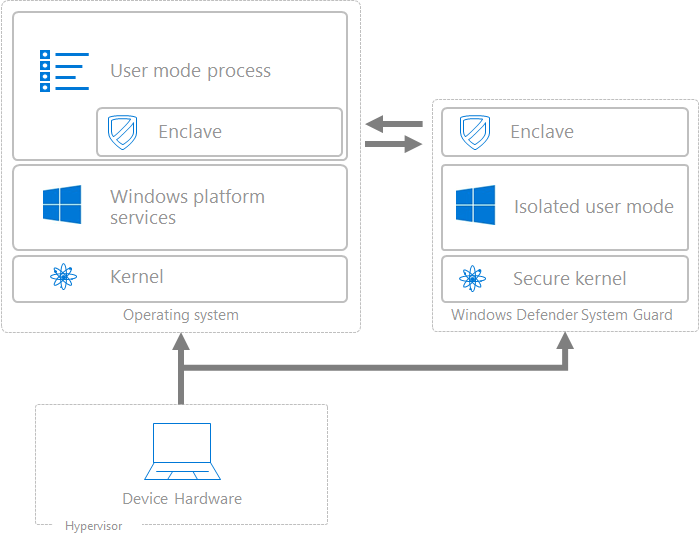
Even before the virtualization-based security feature was introduced this has been the Hyper-V architecture, on server and client SKUs. The management OS is referred to as the "parent partition" or "root partition," and it runs on top of the hypervisor: https://learn.microsoft.com/en-us/virtualization/hyper-v-on-...
It's various pieces are called Virtualization Based Security/Core Isolation/Hypervisor-Protected Code Integrity
> Virtualization-based security, or VBS, uses hardware virtualization and the Windows hypervisor to create an isolated virtual environment that becomes the root of trust of the OS that assumes the kernel can be compromised.
> While VBS greatly improves platform security, VBS also changes the trust boundaries in a Windows PC. With VBS, the Windows hypervisor controls many aspects of the underlying hardware that provide the basis for the VBS secure environment. The hypervisor must assume the Windows kernel could become compromised by malicious code, and so must protect key system resources from being manipulated from code running in kernel mode in a manner that could compromise security assets.
As far as I know, this doesn't limit CPUs to 8th Gen and newer. Neither does VT-x and the other requirements.
Furthermore, there are supported ways of disabling VBS entirely so the gimped version of Windows 11 that doesn't use VBS you'd get for installing it on older hardware wouldn't be that different from an install you'd disable VBS on to get 15% better performance in video games.
Yes if you enable Hyper-V the main Windows installation is running under a hypervisor, but it's running with nearly complete access to the physical hardware.
It's not a problem for Windows, it's a problem for AWS: only metal instances support nested virtualization. To this very day you can't use WSL2 on most EC2 instances.
It's also a problem for Microsoft's new ARM64-based Surface devices: Snapdragon X doesn't support nested virtualization, even though Windows does.
Thank you for this correction. That gives me some hope, then, that maybe we'll get it fixed. I didn't realize this limitation before I bought the device and had to find out when I got the Hyper-V error message :/
AWS has a service providing license-included Visual Studio development VMs for enterprises. These run on EC2 but the users don't have access to AWS services in that sense. These VMs can't run WSL2 because of the lack of nested virtualization. This ends up being fairly painful for Windows-based development; WSL is used for lots of things, integrated with our Windows environment, and WSL1 is much slower.
It's not really conducive to use a separate machine for these development use cases; WSL is integrated to the Windows side more tightly than a separate VM is. For instance, you can launch Windows EXEs directly from the Linux side as if they were native, so you can have a single script that runs tools from both sides natively, on the same computer, without remoting or SSH or anything like that. This all works with WSL1 too (which doesn't use virtualization), it's just a lot slower.