Thanks for pointing that out, I need to remove that submissions page altogether, the magazine has been shut down for five years and you found your way to a vestigial part of the site that almost nobody visits anymore.
I don't know how I ended up there! seconds later: oh, I clicked "original short stories" on the top of the page. and I have been thinking about trying to write some short stories myself and was immediately thinking "I wonder how I would go about submitting one somewhere" and then I saw that link...
First I just want to say that it's an honor that you took a look, I've read and enjoyed many of your articles in the past.
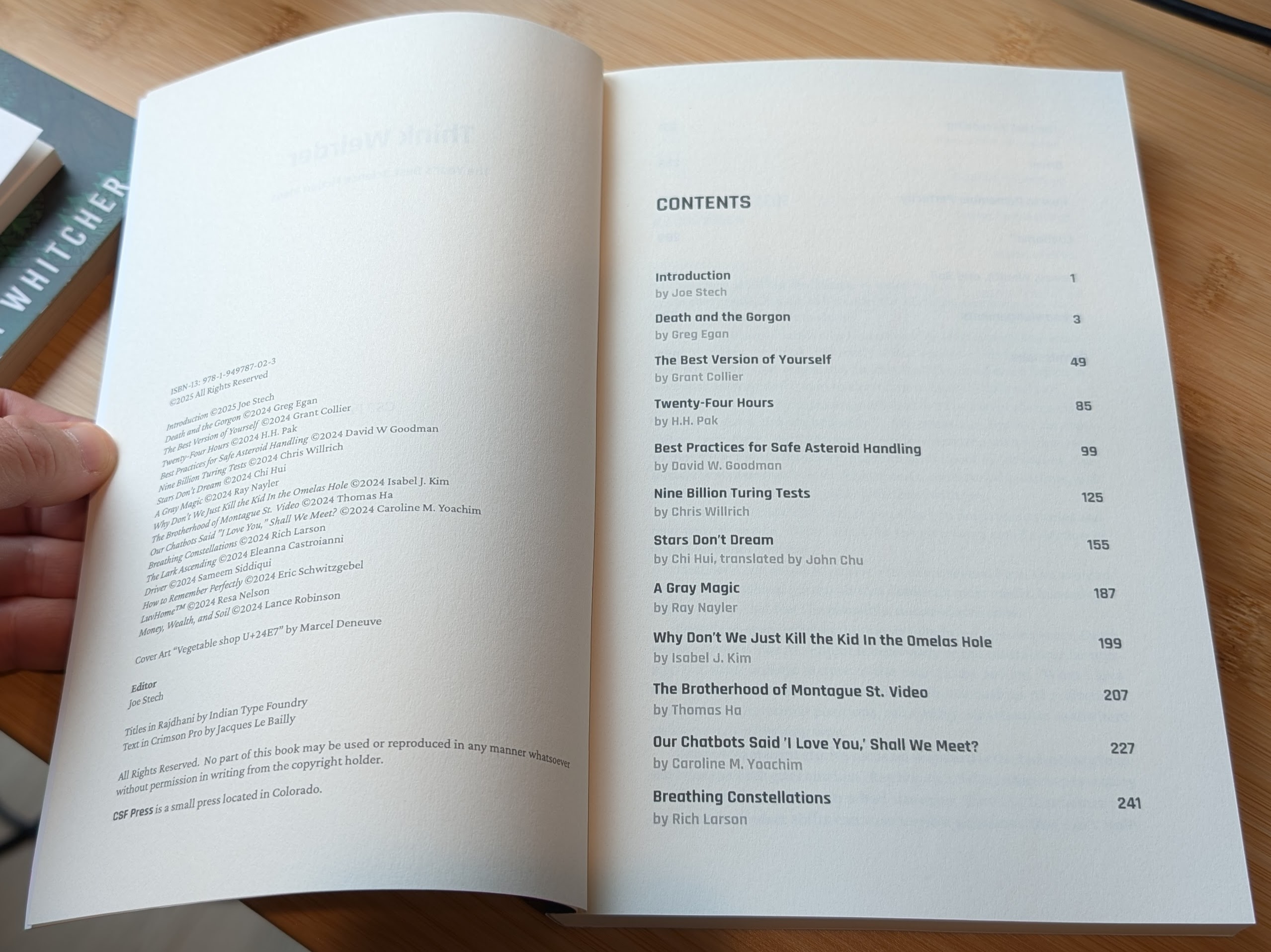
This anthology is actually a "Year's Best" -- they're reprints selected from a pool of 391 stories printed in the big science fiction magazines last year. So I'm not opening for submissions, or anything like that (I have done that before, back when I published a magazine). For this anthology I reached out to the authors about the best concept-driven stories I read last year, and fortunately they all agreed to let me publish their stories.
I have been reading old ones (very old, in some cases), they can be quite hard to find and I am absolutely blown away by the quality and the depth of vision in some of those older collections. Stories whose writers never had a second piece in print anywhere.
Short story SF is a very interesting genre to me and I'm super happy to see you make this effort.
Yes, I plan on releasing one annually, based on the best concept-driven science fiction stories from the previous year. Any more than that and it would take too much time, but one per year is sustainable for me.
I agree that there are many forgotten gems in old science fiction short stories. I just counted on my bookshelf, I own 19 of those old collections in physical form and I'm sure many more in ebook form.
I really dislike Ron L. Hubbard but besides having a knack for tooting his own horn he also had a great eye for good stories.
Have you thought of asking the writers that have already 'arrived' to write a short story on commission? That would lift up the stature of all of the stories you've picked out to be curated. I saw you mentioned Greg Egan, that is definitely a big name.
My favorite collection recently was "The Collected Stories of Vernor Vinge". It spans his short fiction from 1965-2001.
I've considered commissions many times, I go back and forth on it. I wouldn't want to put a commissioned story into a "Year's Best" anthology, just because I truly want it to be a "Year's Best" -- i.e. I need to evaluate ALL the stories published to the best of my ability and choose the best regardless of name recognition.
I could commission some and create a new themed book separate from the "Year's Best", but that's hit and miss. The main issue with commissions for me is that you never really know if the thing you're commissioning is going to turn out how you want. If the authors are well-known it will probably be good, but I've had many editor friends commission stuff that was just phoned in.
> My favorite collection recently was "The Collected Stories of Vernor Vinge". It spans his short fiction from 1965-2001.
I re-read that one just after he died. Amazing stuff.
> I've considered commissions many times, I go back and forth on it. I wouldn't want to put a commissioned story into a "Year's Best" anthology, just because I truly want it to be a "Year's Best" -- i.e. I need to evaluate ALL the stories published to the best of my ability and choose the best regardless of name recognition.
That's a good point. Otoh, 'best' is always going to be subjective and you could make it explicit: A novel short story by X and the best of Y.
> I could commission some and create a new themed book separate from the "Year's Best", but that's hit and miss. The main issue with commissions for me is that you never really know if the thing you're commissioning is going to turn out how you want. If the authors are well-known it will probably be good, but I've had many editor friends commission stuff that was just phoned in.
Ok. That's probably a matter of having an authentic connection to the writers whose work you would like to commission.
I used to run 'daz.com', as a community for people interested in music, much like Musicbrainz, with connections between bands through collaborations and shared individuals to help discover new music. As a side project I thought of commissioning a piece of music. This really opened my eyes to what it costs to produce a high quality piece and that was priced right out of the ballpark but what struck me is that the few artists that I had contact with all had already used the site and had made sure that their own record there was accurate. This was amazing and made me quite happy, even so, they had pretty high standards and when all was said and done it went nowhere. We did manage to raise the profile of a few artists whose work was otherwise less known and I made a number of very interesting contacts.
I'm not going to name drop anybody but suffice to say that I found it amazing that you could just reach out to A-list artists and get a well thought out and very helpful response.
That's really cool! Yes, it's always been amazing to me how many people will respond helpfully to a random cold email.
And well-known authors are similar to other artists in the fact that they have steep rates for commissions. For instance, https://clarkesworldmagazine.com pays a flat reasonable rate of 14 cents per word ($840 for a 6k word story). I've talked to well-known authors who would charge $5/word for that same story on commission ($30k)
Thanks for your support! I believe I understand where you're coming from, some of the stories have more novel concepts than others -- Twenty-Four Hours is hard to discuss without spoilers, but I selected it because the characters and setting felt very real, while at the same time it would completely fall apart without the technological concept.
As I wrote in that blog you linked, I tried to interleave the stories so that you get alternating vibes as you go through the book. I know not every story will be for everyone, but I hope you find most of them interesting!
I plan on pursuing as close to the same process as I can next year, I want to put out the most consistently concept-focused Year's Best out there.
Thanks for sharing some of the methodology and code for how you put your book together.
Are you comfortable speaking about the financial side? What does an editor get per copy sold, what does an author get?
(In the science world, for instance, editors tend to get money often, but authors never get paid for articles or book chapters.)
Hopefully, now that you have experience in the process and all your code ready, you can repeat the exercise with higher efficiency and profitability.
Happy to talk about it, the TL;DR is that this is a hobby where I as the editor don't expect to make back the money I spent creating the book, but the authors get paid a fixed amount up-front. Here's a more detailed answer: https://news.ycombinator.com/item?id=45785154#45879003
The only addendum to that answer is that after being featured on HN last week I'm now over halfway toward break-even.
The reprint rights agreements were all extremely manual, I did everything through email and SignNow. Mostly payments went through PayPal, although there was one author who wanted a physical check mailed.
Thanks, you're completely correct, rights acquisition was the most difficult part!
The absolute hardest story in the anthology to get rights for was "Stars Don't Dream" by Chi Hui. It's a translation of a story that won an award in China, but Chi Hui doesn't speak English, and her contact info was extremely hard to obtain (I had to get help from the editor of Clarkesworld Magazine). We did the entire contract discussion via a combination of Google Translate and my very weak Mandarin I learned in college.


reply