Giving someone $500 or $2000 once and measuring the impact of that, and then extrapolating it to UBI makes no sense. A one-time cash payment isn't a psychological safety net. It's winning a slot machine once. In fact, you probably know it isn't going to happen again, which could even be worse.
If you give me one time payment like that, it goes in the bank and I don't think about it because it doesn't significantly change anything.
If you give that same amount to someone in poverty, at best they pay down some debts but it doesn't significantly change anything. They are typically in a financial hole and that doesnt fill the whole but might reduce the depth a little.
”The data are most consistent with the notion that receiving some but not enough money made participants’ needs---and the gap between their resources and needs---more salient, which in turn generated feelings of distress.”
Idk if we want a psychological safety net tho. Like we already have crazy low rates of saving so we want more of that. Seems like a psychological safety net will make an already low savings rate lower?
6 in 10 Americans don't have $500 in savings [0]. You really don't see the problem with that????
People can't handle important expenses without savings. So they turn to bad solutions like credit card debt which is really expensive long term or defaulting on loans which makes future credit harder, stuff like that harms long-term financial health.
(also because the way things are going we will have people retiring who can't afford it and no fucking way am I paying for it)
Right, so the problem is people don't have money because obviously people would save if they could. Giving them money would allow them to do that. This is exactly what the proposal is intended to resolve, so it doesn't make any sense that you'd argue against it unless you have some other idea of how to get people money so that they can save it.
You cannot do financial planning or anything. Maybe you can get some new clothes or few other necessities but it cannot change the course of your life. You might get better return if you just go to a casino and bet it all on red.
I don’t understand why the researchers thought that this was unexpected result.
Now if they had offered 2k per month for life to these impoverished individuals, then this is where I anticipate to see a step change in their quality of life .
Nobody thought a one off $500 or $2000 will be life changing and it's not what the researchers were surprised about.
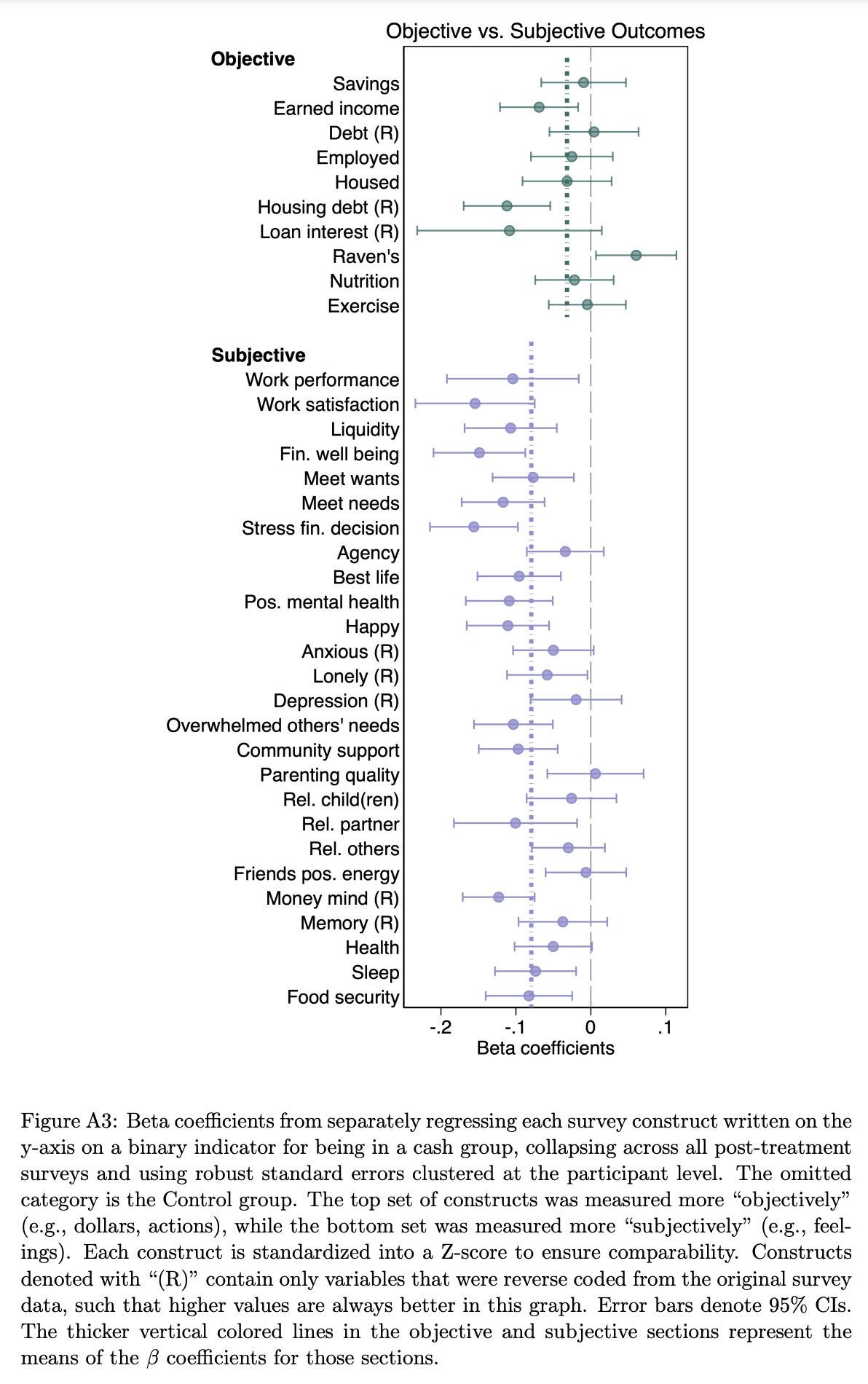
The surprise is that on most subjective well-being metrics, the groups receiving some windfall cash reported significantly worse after getting some extra cash than the control group (equally poor, receiving nothing.)
They thought it was unexpected because it was unexpected. From the abstract:
"These findings stand in stark contrast to the (incentivized) predictions of both experts and a nationally representative sample of laypeople, who - depending on the treatment group, outcome, and time period - estimated treatment effect sizes of +0.16 to +0.65 SDs."
Using the 4% rule on $5k, your monthly payment would be $16 / month. The 4% rule is generally used for an on time retirement, so there’s no reason to believe you’d be able to maintain your $16 / month payment in perpetuity.
I don’t think $16 a month is going to change their lives any more than buying necessities they need now with the $5k, but I guess we’d need another study for that :)
If all you’ve got is $5000, that “endowment” still isn’t going to remake your life. Perpetual endowments usually spend about 5% of their market value per year, so you would receive about $20/month. Not nothing, but not life-changing either.
Since you’re not going to live forever, you could draw a bit faster—-but transaction costs are also going to eat into that too.
To all those saying it was obvious how one-off cash transfers wouldn't do anything, you need to explain (1) why both experts and laypeople thought ex ante they would do something:
"These findings stand in stark contrast to the (incentivized) predictions of both experts and a nationally representative sample of laypeople, who - depending on the treatment group, outcome, and time period - estimated treatment effect sizes of +0.16 to +0.65 SDs."
and (2) why they seemingly do have an effect in less developed countries:
"UCTs generally (though not exclusively) have a good record
of improving outcomes for recipients in low-income countries (Baird et al., 2014; Bastagli
et al., 2019; Dwyer, Stewart and Zhao, Forthcoming; Manley, Alderman and Gentilini, 2022;
McGuire, Kaiser and Bach-Mortensen, 2022). For instance, they have been found to raise
recipients’ consumption, improve children’s health, and reduce intimate partner violence."
For one thing, it's a very small amount of money. You won't be able to turn it into a better job, better housing, or pay off your debts. Credit cards will regain the balance soon, or a dentist bill will wipe out the savings.
Everyone wants to get free money. That doesn't mean that a small one time payment will actually make a substantial difference in the long run.
Do these lesser developed countries have Medicaid, food and housing assistance, and high household debts? If I had to guess, the money went towards very different things, and the situations really aren't comparable. In fact, I suspect that the ease with which Americans can get into debt- hospitals charging after service is provided, credit cards, etc- may be the most significant factor.
Also of note, the $500 payments are less than the extra additional unemployment payments made during COVID, and if you have kids the $2k were less than the stimulus checks.
→ a new Harvard study found giving low-income Americans cash isn’t that helpful. Researchers gave 5,000 US participants $2000, $500, or nothing. “Within 4 weeks, we see no significant difference in bank balances between either cash & control groups,” wrote one of the study authors. And: “We find NO positive effect of cash—if anything, in some prespecified analyses, we even see negative effects.” Apparently the cash infusions added stress to people’s lives, which makes sense (likely family and friends came knocking).
... and after having spent more than 50 pages in describing the experiment and its results and analyzing any number of (wild) guesses, the researchers actually talked to 15 (fifteen) people of the 5,000 (five thousand) involved in the experiment and half of them told the researchers how the money was not enough:
>Indeed, after the study concluded, we conducted qualitative interviews with 15 participants, where—among other things—we asked them how much money they would have needed to receive for it to have made a difference in their lives at that time. About half of participants indicated that they would have needed to receive more than $2,000, with those responses falling between $4,000
and $25,000. Although this is by no means a representative sample or ideal methodology, these responses may at least be indicative of the general order of magnitude needed.
How surprising is it that someone who is living at the poverty level or under it when given a "small" amount of money (no matter if 500 or 2,000) after one month has spent it?
It really seems like an insultingly small amount of money. It's almost like they're trying to disprove something like UBI by association while not actually doing something that's useful.
If they'd given those randomized amounts monthly for a year or 5 years, I would bet the results would be in line with similar studies which show marked benefits.
Yeah were they expecting them to get $500 and within 4 weeks start a company and become cash flow positive? Being poor is often a consequence of education and with a few years of guaranteed income to make them feel safe to take that risk, they probably would have been able to tackle that. But it's not surprising at all that nothing happens in just a month.
Gook luck trying to fund a sufficiently powered RCT to give people $2/month for a year, let alone 5. $2k for 5 years is $120k per participant, so about $120M for a 1000 sample size study.
Sure, but imagine making a medical experiment where you give once 1 mg of the drug (that should be dosed at 1 mg/day as per results of previous experiments for at least 2 weeks) and then writing an article in which surprisingly it comes out that it didn't work well.
This is the funniest thing I've seen all week. "found giving low-income Americans cash isn’t that helpful ... see no significant difference in bank balances"
Funniest because it proves the complete ignorance of those without poor problems.
Of course there is no more money in the bank. There are dozens of things more important than money in the bank.. the brakes that should of been replaced 8 months ago. The tires that are unsafe. Dental health. Many more.
'We find NO positive effect of cash—if anything, in some prespecified analyses, we even see negative effects.” Apparently the cash infusions added stress'
Of course - it's stressful trying to choose - do you spend the 500 on your kid's teeth or do you get your teeth worked on? Do you spend 500 at the vet or buy healthier food for the family this week. Do you replace your brakes or the tires? Do you fix the brakes or go to the dentists? Do you feed your kids better or stop the parasites sickening the pets. Do you X or Y? Should you Y or Z?
Yes those things are stressful, and certainly more stressful than 'I can't afford any of these things and that's the way it is so stop stressing it' - I'd like to say "Duh!" - but I don't think the high brow harvard study would really get it.
Although I disagree with 'found giving low-income Americans cash isn’t that helpful' - I mean it's stressful - but at least it is helpful in fixing on or two of the life changing things that need fixing - so it is helpful. It's just when you have a dozen life altering debts accruing life changing interest already (deferred maintenance leading towards bigger problems) - a couple grand does not fix all the things that need fixing in the American life.
Maybe there is some other place in the world where you can get all of your healthcare, vehicle maintenance and other necessities all taken care of for $2,000 (?) - maybe those folks could put some money in the bank.
Yes, it is usually intended as a monthly payment, BUT the actual UBI (in theory) doesn't (and shouldn't) pass through a "means test", i.e. (still in theory) it is "Universal" and as such all citizens should get it regardless their income or estate, as the Wikipedia article highlights:
>This article is about the system of unconditional income provided to every citizen. For the means-based model of social welfare, see Guaranteed minimum income.
Indeed. One of the main criticisms of both Canadian major experiments with UBI (Manitoba in the 70s, and Ontario in the last few years) was that while they paid regularly, both programs were relatively short-lived -- a few years. This doesn't appropriately model the incentives and behaviours people would likely engage in if they knew with reliability the program would still be paying them in ten or more years. It wouldn't capture either negatives like people leaving the workforce permanently, or positives like going back for a four year degree they couldn't otherwise afford. Participants likely treated it as a one-time windfall (if over a couple years).
They made a good point here that this isn’t a random sample:
“ All participants had previously applied to the organization for COVID-19 relief funds (and thus, presumably needed money). The ways in which people learned about and came to apply to the non-profit varied, with some being referred by municipal agencies (e.g., housing authorities) or social service agencies, and others conducting internet searches. About 43% of our participants (2,237 people) received funds from the non-profit before the trial began. The overwhelming majority (99%) of these participants received $500, with a median of 243 days between a participant’s pre-trial payment and the start of the trial. Less than 1% (45 participants) received a payment in under four months of when they began the trial.”
You're misunderstanding the point of the study. It wasn't meant to determine "is a one time payment going to solve poverty", it was "does it improve anything" and the answer is no, it doesn't, and it actually distresses the recipients.
I would expect that halving their monthly payments on that debt would have a significant effect on their monthly budget. Why wouldn't that be the case?
They know they’re just gonna have to max out the credit card again for that thing (one of many!) they’ve been putting off for months. The poor always have another bill lurking to wipe out a small windfall like this.
This is UCT, not UBI. We already have a lottery, and we already know the outcome — the population at large still has home/food security issues. No additional study was necessary. It almost feels like they used the term “UCT because it is similar to “UBI”. I feel like this is disingenuous.
Regarding UBI: do people not understand that money only makes sense in the context of a liquid market? UBI is a (non-linear) offset to a baseline wealth level. It can’t solve anything itself.
Having to deal with invasive, faceless bureaucracy every month to receive a meager income is incredibly stressful, and not only to disabled and elderly people. Prolonger survival stress is extremely detrimental to mental and physical health, and a guaranteed UBI would completely remove it from existence.
The state would benefit from not having to employ literally thousands of bureaucrats… which is likely the reason UBI will never happen at scale, as it would put too many people out of a comfortable position of power.
Also, fraudulent claims would no longer be a thing, since everyone would get the same benefits, likely in relation to their other income. If someone was capable of finding a way to hide their income, they are probably already committing such fraud in the current system.
COVID payments have nothing to do with UBI. At least here in NZ, most of the support was paid out to businesses and corporations. Fraudulent ones, too.
Maybe if you weren’t so concerned with ”outsiders” getting a piece of your welfare, you could actually have a functional society.
Your second and third points are directly at odds, as a huge portion of people employed in government social-financial schemes are compeltely dedicated to answering the income question.