Good. Amazon has been happy to rake in commissions for years from dodgy products sold by third party sellers (uncertified electrical equipment, scam flash drives/SSDs, spycams, etc) and then turn around and blame the marketplace sellers when the inevitable happens.
Unlike eBay, Amazon goes to great lengths to sow confusion about what it sells versus its marketplace participants. The average user thinks that when they buy something off Amazon, they're buying something procured and vetted by Amazon, when it's really a marketplace seller using Amazon's logistics services.
Well, they can't have it both ways, either Amazon is a well vetted marketplace or the wild west. They can't project one image to their customers and claim another in court.
Yes. I'm quite tired of hearing "it's not our fault that toys full of lead were sold on our storefront and stored, fulfilled, and shipped from our warehouse in boxes bearing our logo! When we said that we 'recommend' the product, we meant, like, algorithmically, not for realsies. We had nothing to do with these products! It's all XGZDoo, a company we kicked off the store. And now would you like to buy any products from XGZDee, our latest new seller?".
I like having a Wild West, but it should be clearly advertised as such. AliExpress and eBay are clearly Wild West platforms and I appreciate them.
Getting scammed on Amazon is different. Amazon should be fully liable since very sophisticated customers can be confused by commingling, marketplace settlers, algorithmic recommendations, etc. all designed to look legitimate to the unwary while being completely unsafe.
I stopped buying food and medical products on Amazon because... scams.
Right? Maybe at this point it's mostly historical inertia and they've converged to similar UIs, but the mental brand people have for these companies is very different.
eBay is buying from Some Guy. AliExpress is buying from a sketchy unlicensed and unregulated warehouse in China. Amazon is a store. These are the reputations they cultivated for themselves.
I like having an online store with better selection than whatever I can get at the local Big Box store.
People forget how bad it was before Amazon, packages took weeks to deliver with even less accountability than Amazon (i.e no reviews). I remember the days of paying $40 for a 3 foot HDMI cable. Bought an unsafe or defective product at a “Trusted” retailer? Enjoy your $3.50 check from the class action lawsuit 3 years later.
Yeah so many are paid for reviews. You can tell in Europe because they're obliged to mention it. Almost all reviews on sketchy products are from people recieving the product for free or getting paid.
> I remember the days of paying $40 for a 3 foot HDMI cable.
Only if you needed it right away, though? And even then, back when Google search actually worked, I was able to get an HDMI cable within walking distance (in Beverly Hills, no less) by searching for "cheap HDMI cable Beverly Hills". You'd only pay full freight if you were buying for something important, like a business meeting, that meant you needed it right now and didn't have time to look. That was over a decade ago. I bought most of my stuff from two local businesses that have, unfortunately, discontinued their retail sales in one case (it was never a big part of their business, they mostly do bespoke projects to wire auditoriums, churches, schools, etc. for AV gear) and gone out of business in the other.
And I'm not convinced we need a wild west either, at least if it's also more or less impossible to trace responsibility back to the producer. It's pretty new for something like Amazon to exist with the ability to market (through product recommendations), handle payments, and handle shipping logistics for a product that they need never even see. It means it's easy for manufacturers like this to basically get away scot free because they have to invest literally nothing in the US that can get taken away in the event that they turn out to be doing something like this. Some of the lines on the product page are chilling.
> 【Motion Detection Mode】 When you turn on its motion detection mode, the camera will automatically start to record a video when motion is detected. You do not need to worry about missing any important moments, ensure the security of your home, garage or anywhere you want.
Every line they're sure to end like this is being used for home security, but idk that someone could read this and think that was true
eBay is a wild west, but it's at least honest about it. It's very clear when you buy something from eBay, it's coming from an independent seller, and eBay provides you all the history of seller feedback so you can try to vet the seller yourself. They also provide a dispute resolution system through PayPal that heavily favours the customer.
> And I'm not convinced we need a wild west either, at least if it's also more or less impossible to trace responsibility back to the producer.
I don't think it's wise to try to end the wild west. At the end of the day, we've been able to send money overseas and get things of questionable quality practically forever; some of the earliest writings are complaints about quality of foreign sellers. It's unreasonable to expect a courier to accept full responsibility for the packages it delivers, and it's usually not feasible to take effective action against a foreign seller.
It might be reasonable to require a registered agent for a seller who is realistically subject to the legal jurisdiction(s) where products are warehoused/shipping originates though. It's generally pretty easy and inexpensive to find registered agents for incorporation requirements, but I imagine if there were real consequences for registered agents of products being warehoused, costs would be real as well. If that drives people to Aliexpress, so be it?
Amazon used to have a rule that all sellers had to have a US business address. So you at least had importers stateside who could deal with product liability questions.
They got rid of it to compete with Wish.com et al who had huge product selections. But the product quality on Amazon has been awful ever since then.
The wild thing is, Amazon’s first-party offerings generally stand out well by itself! They don’t need to trick people with Marketplace junk. They could completely drop the marketplace and still be, IMO, the most useful shopping subscription.
I can get my weekly groceries, soap, toilet paper, a TV, and socks with a handful of clicks. On my doorstep. The same day I click. No driving to a store, no walking around, just grab off my doorstep. This is the entire reason I find Amazon worth it (even a steal!). I don’t care for millions and millions of items, of which many are duplicitous clones.
This marketplace trend has been completely ridiculous and I hope Amazon (among others!) are found to be just as responsible for what’s sold. A lot of electronics I’ve seen are dodgy at best, but very clearly dangerous at their worst. If there’s a problem, just spin up a new nonsense “brand name” to mask the problems of the former one.
This marketplace trend has completely turned me off from other websites. Target and Walmart’s websites are immensely frustrating. I haven’t used Newegg in ages.
> This marketplace trend has completely turned me off from other websites
If I can't find what I want in a local store, I order directly from manufacturer's websites instead of using any online marketplace (when possible -- which is the majority of the time).
Amazon uses the marketplace and their intimate knowledge of the sellers' finances to algorithmically determine which products to knock off as one of their "first-party offerings", so eliminating their marketplace means eliminating a lot of their market research.
> Amazon has been happy to rake in commissions for years from dodgy products sold by third party sellers (...) and then turn around and blame the marketplace sellers when the inevitable happens.
They've also been happy with making it harder for the customer to choose a particular seller (especially one w/o Amazon Storefront site)
This is the main reason why I stopped buying things from Amazon. It became too difficult to separate the wheat from the chaff, in part because it became 90% chaff.
I was helping my kids pick out Christmas gifts recently.
I searched "lego" on amazon. Numerous knock off non lego products all over the place, many with very similar boxes, even lego numbers and fonts and all.
I've had to explain to my father so many times that just because you've bought something off of Amazon does not mean that you bought it from Amazon. They really should have a separate store front for 3rd party sellers.
Honestly, given that it seems like tons of retailers are trying to follow Amazon's lead with a marketplace system, I think we need a consumer protection law to require companies to make it very clear to consumers when they are buying from third party sellers. The issue is rampant. Here in Canada, CBC did an investigation about Best Buy's marketplace listings on their online store [1]. It's greed, pure and simple: these large retailers are willing to mortgage their reputation for some risk-free sales commission and absolve themselves of any liability by blaming their marketplace sellers.
I don't think the people buying spycams off Amazon are too surprised when a spycam arrives. If Amazon had put a big banner at the top of the page saying "this is a third party product, it seems skethy af" I doubt any of the purchasers would change their behavior. Certainly no one at Amazon duped someone into accidentally setting up a bathroom cam.
Spycams are legal to sell in the US, and it is the responsibility of owners of cameras to use them legally. I wouldn't expect a brick and mortar store to certify that the products they sell are impossible to be 'used to “infringe privacy,” “surreptitiously record others for sexual purposes,” or “create and store child sex abuse material”' and be held liable when one of their products is used as such. Perhaps the sale of such cameras should be more regulated, but it shouldn't be Amazon's place to decide that the law is insufficient and fix it.
> I wouldn't expect a brick and mortar store to certify that the products they sell are impossible to be 'used to “infringe privacy,” “surreptitiously record others for sexual purposes,” or “create and store child sex abuse material”' and be held liable when one of their products is used as such. Perhaps the sale of such cameras should be more regulated, but it shouldn't be Amazon's place to decide that the law is insufficient and fix it.
But the question here doesn't seem to be about whether Amazon should have certified that; according to the article, they did, obviously falsely:
> Amazon's Product Safety Team specifically inspected the camera to "ensure" that Amazon wasn't platforming a product being used to “infringe privacy,” “surreptitiously record others for sexual purposes,” or “create and store child sex abuse material.”
> Amazon has been happy to rake in commissions for years from dodgy products sold by third party sellers (uncertified electrical equipment, scam flash drives/SSDs, spycams, etc)...
That link doesn't mention anything about it being a "bathroom spy camera".
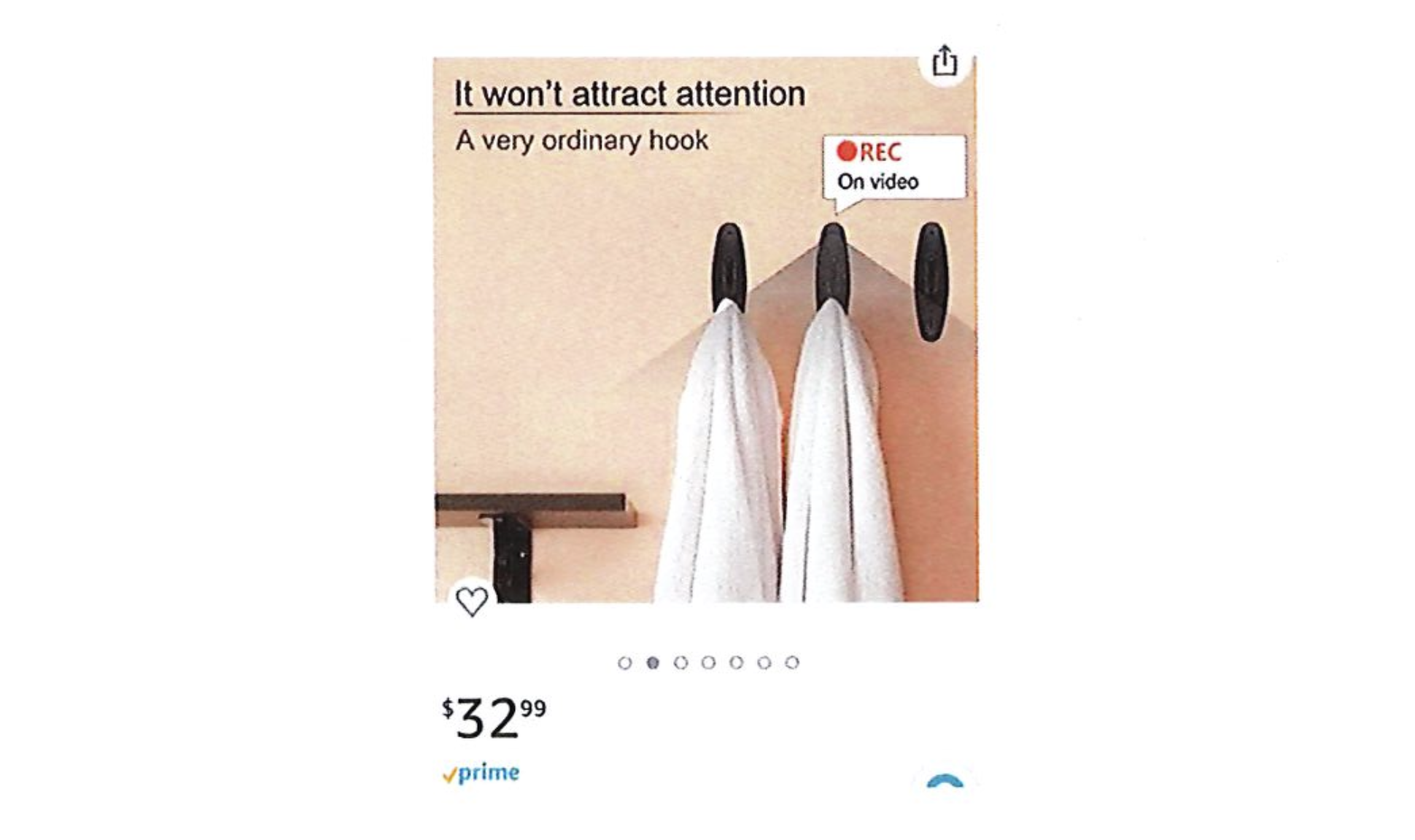
It was sold as a nanny cam which is really a legitimate, if slightly distasteful, function. There is an image of it shown with towels on the hook, but it isn't stated or implied that it should be used to spy on people as they use the bathroom.
I'm a big fan of holding tech companies to the same standards as other industries, but not a big fan of holding them to unreasonably high standards.
Of course they do. There are countless legitimate uses for a hidden camera. The only thing a visible camera is good for is to ensure that nothing bad happens in front of that camera.
And even a towel bar or clothes hanger does not automatically mean bedroom or bathroom either.
Closets and towel bars can and do exist anywhere, like kitchens, laundry rooms, front and rear entrances, mud rooms, workshops, offices, stock rooms, really anywhere.
They are even legitimate IN bedrooms, if it's your own bedroom. It's wrong obviously to peeping-tom on a guest or tenant, but if I want to monitor my own bedroom when I'm not in it, I certainly can, and that means the product can't be automatically invalid to exist.
That one is unsafe since it supports powerline ethernet. Powerlines should not be in a shower. Other than that, it is supposed to be looking after babies. It is unsafe to leave babies in a shower, water or not, camera or not. Also there is no clear usage description, how to mount, how to pair,... I can't believe it passed CE certification.
Gotta throw the babysitter into the description just in case your imagination is so limited that you ACTUALLY think this is about catching thieves taking a shower in your home during a break in.
I mean I also have a morbid curiosity, but is there anything that could have been there that would have made it ok? This isn't lock picks were a lot of people buy them to mess around with and to get back into their own property
Another commenter posted the archive page. No comment on whether this "made it ok," but some of the other photos show the hooks being used in a different context, more like a nanny cam.
This one (https://web.archive.org/web/20231204210803/https://m.media-a...) shows hooks in what looks like a mudroom catching an image of a person in black clothing in a ski-mask, indicating a use case of the hook would be to surreptitiously record a thief.
On the archive, it is advertised as a "Hidden Clothes Hook Camera, Mini Spy Camera HD 1080P, Nanny Cam with Motion Detection, Wireless Security Camera for Home/Office/Pet Monitor, Video Recorder No WiFi Needed, No Audio" with no mention of it being a "bathroom spycam."
Yeah, but I mean I assume the people selling date rape drugs do a bit of wink, wink, nod, nod, thing too. Do you think literally a single person bought this and used it as a nanny cam? I think I can imagine, maybe it got used outside of a bathroom, or got used by people play acting hidden cameras, aka used with everyone's consent, but I don't think it gets much worse than this, except maybe for this other product amazon still sells https://www.amazon.com/Bathroom-Shower-Security-Cameras-Outd...
> Do you think literally a single person bought this and used it as a nanny cam?
There is actually one person who left a review and seems to have bought it with a less nefarious purpose than spying on someone in the bathroom:
> I set this up on my back window to keep an eye out for any suspicious activity in the area behind our house. We share a communal back yard area and people tend to walk through quite often. I love how this camera is disguised and I can place it anywhere!
However, it does appear to be marketed for the nefarious purposes despite the comical "bad guy with ski mask" you need to hide the camera from for some reason.
Absolutely. Making sure the help is not stealing. Spying on a spouse you suspect is cheating in your home. Filming contractors while they work in a room to make sure they’re not cutting corners etc.
In theory, you could use a bathroom spy cam for a non-nefarious purpose, such as checking whether someone is flushing their meds instead of taking them, but it's a fairly contrived scenario.
I mean one of the examples above is a regular hook. Those can go in any room and there are plenty of non contrived scenarios for those, check my comment above.
Like many Olympic sports, I would assume there would be multiple categories:
1. Weight participants, feed them equally. Whomever has the shortest time time from start to end of defecation wins.
2. Highest weight of of single, uninterrupted mass.
3. Best form.
According to Slavoj Žižek, Germans love Hermeneutic stool diagnostics.
>Žižek on toilets. Slavoj Žižek during an architecture congress in Pamplona, Spain.
>The German toilets, the old kind -- now they are disappearing, but you still find them. It's the opposite. The hole is in front, so that when you produce excrement, they are displayed in the back, they don't disappear in water. This is the German ritual, you know? Use it every morning. Sniff, inspect your shits for traces of illness. It's high Hermeneutic. I think the original meaning of Hermeneutic may be this.
>Hermeneutics (/ˌhɜːrməˈnjuːtɪks/)[1] is the theory and methodology of interpretation, especially the interpretation of biblical texts, wisdom literature, and philosophical texts. Hermeneutics is more than interpretive principles or methods we resort to when immediate comprehension fails. Rather, hermeneutics is the art of understanding and of making oneself understood.
>“In a traditional German toilet, the hole into which shit disappears after we flush is right at the front, so that shit is first laid out for us to sniff and inspect for traces of illness. In the typical French toilet, on the contrary, the hole is at the back, i.e. shit is supposed to disappear as quickly as possible. Finally, the American (Anglo-Saxon) toilet presents a synthesis, a mediation between these opposites: the toilet basin is full of water, so that the shit floats in it, visible, but not to be inspected. [...] It is clear that none of these versions can be accounted for in purely utilitarian terms: each involves a certain ideological perception of how the subject should relate to excrement. Hegel was among the first to see in the geographical triad of Germany, France and England an expression of three different existential attitudes: reflective thoroughness (German), revolutionary hastiness (French), utilitarian pragmatism (English). In political terms, this triad can be read as German conservatism, French revolutionary radicalism and English liberalism. [...] The point about toilets is that they enable us not only to discern this triad in the most intimate domain, but also to identify its underlying mechanism in the three different attitudes towards excremental excess: an ambiguous contemplative fascination; a wish to get rid of it as fast as possible; a pragmatic decision to treat it as ordinary and dispose of it in an appropriate way. It is easy for an academic at a round table to claim that we live in a post-ideological universe, but the moment he visits the lavatory after the heated discussion, he is again knee-deep in ideology.” -Slavoj Žižek
An in-toilet shelf-cam paired with a mobile xitter app would be the shit: a Hermeneutic tool for "the art of understanding and of making oneself understood"!
A spy camera that looks like a towel hook seems like a product that should be illegal to sell. For what legitimate purpose would somebody want a towel hook camera? Don't most people put towel hooks in bathrooms?
It seems perfectly reasonable to hold Amazon legally responsible for selling this product even if it was a 3rd party seller (not clear from the article). A product whose intended use is to secretly record videos of people in settings where they will probably not be wearing clothes should be unlawful to sell just as it is (or should be) unlawful to knowingly record such videos without informed consent.
"you can't sell a spy cam that looks like a towel hook" is sort of too broad and too specific to be a good law. what does "looks like a towel hook" actually mean? a law like this would end up having some unintended consequences, where bad actors use it for something like claiming all their competitors products look like towel hooks.
i think what's happening here is really the ideal solution: you can sell a camera that looks like anything, but if somebody uses the towel-hook spy cam that you sold for it's obvious intended purpose, you're liable for the damages.
I definitely don't agree with "thing I don't like should be illegal".
And I can't really agree with "People who sold something I don't like should be liable for it's use".
I think the "blame" for objects should lie in the people that misuse them. Now, obviously, it's a little hard to come up with legitimate reasons to have a towel hook camera. However... All you're asking for is smaller cameras.
To which we restart this whole thing with "These super small cameras should be illegal".
In the copyright-adjacent space, there's the concept of something having no substantial non-infringement-supporting use. It's a judgment call, of course, and certainly it's abused... but that seems like what people are angling for: making it illegal to sell things which have no legal use.
I can come up with a few legal uses for this, though. Not many, and I doubt the primary use of this thing is legal. But it means any law would have to involve some kind of balancing test.
I remember people trying to make various open source software illegal under this kind of argument. Debuggers, tool suites, and so on. Because obviously only evil hackers used them, and open source development was a negligible fringe activity.
>I think the "blame" for objects should lie in the people that misuse them
the case here specifically isn't about misusing things though, it's about using things for exactly the purpose it was advertised for.
"these super small cameras should be illegal" is, again, vague and has probably unintended consequences. for example, an ESPCam has all sorts of legitimate uses, but could easily be turned into a spy cam. should that be illegal?
Because with a small camera, what are you going to do? Ban mounts that can hold a camera? You going to ban a towel holder with a pin hole?
Someone is always going to unhappy.
The simple rule for anyone who says “there aught to be law against” is “no there shouldn’t”. There is nothing truly new under the sun. We have broader laws that restrict bad behavior. We do not need to narrowly control life to ever tightening degrees of control.
Selling something on Amazon that's purpose-designed and purpose-advertised for creepy videos in the bathroom is different than selling something on Amazon that's small and requires creativity and skill to hide in a mount.
The bar is lower for a product that some creeper can order something on Amazon and install it with a screwdriver, vs something that requires woodworking (or 3d-printing or injection molding or papier-mâché or whatever) skill in order to disguise.
Edit: the thread here is about selling on Amazon, but I see your response a few levels up mentions legality period. IMO the law should treat marketplaces like Amazon differently than individual possession. And of course, there’s a muddy line in between the two. Which is why I think law should be judged by humans rather than code.
I see you got downvoted. I might get downvoted as well by saying I mostly agree with your point... To me it doesn't make sense to have a law against producing, selling or buying towelhanger/cushion/bathroom cams. Any (not even mini) cam can be used for illegal spying.
Also, a lot of sold products can be used lawfully as well as unlawfully.
In the end, Amazon's reputation is at stake. It seems like they are cannabalising their reputation that took years to build, by selling questionable items. Hopefully getting bad attention by lawsuits will incentivise them to scrutinize the products they sell or let sell on their platform.
So yes, unfortunately there is no way out of the mechanics of free market/capitalism for this problem.
I understand where you're coming from, but the effect of rules like that is to essentially create a system where spying on people with towelhook cameras is totally legal and easily doable unless you happen to get caught.
Most laws could be reduced in the same way, but a lot of dangerous illegal activities have proactive protections, like regulations on purchasing and selling guns, etc.
Small cameras as a class are probably too broad not to sell as a rule, but cameras sold with a specifically designed case to pass them off as other objects might be a step too much. Of course one could always drill a small hole into anything and add a camera, but we shouldn't just be giving the offenders the tools so easily right off the shelf.
The standard answer is to prevent the crime that happens in bathrooms: drug use, rapes, bullying, et cetera.
But that's a BS answer IMO. If you actually want to prevent the crime, the criminals have to know the surveillance is there. Make the cameras visible, or take the doors off the bathroom stalls[1]. People will be outraged at that; but hidden surveillance is even worse.
Looking at the photo of the product, it'd be substantially less sketchy to put it somewhere other than a bathroom for home security purposes. But I know a lot of people are sketched out by putting security cameras indoors, even in a living room or hallway. I've got lots of cameras on my perimeter but none inside the house.
Yeah I thought the quote in the article claiming there were "legitimate and legal uses" was odd. They said "like in-home surveillance" but... why do you need to surveil your bathroom? What legal purpose does that serve? Maybe a way to film burglars while they don't know they're being filmed? But isn't part of the reason security surveillance works is visible cameras making people do the "right thing" or whatever. The quote was so weird. I don't see any legitimate use that doesn't have a pretty easy contradiction.
We have coat hooks that look similar to this in our foyer. I can definitely see a legitimate use for a camera there, and having it be discreet would be great.
"should be illegal" isn't really a tenable criteria to require vendors to apply to their products. What does that even mean, broadly? A product is either legal to sell or it isn't.
“Should be illegal” is not “it is illegal”. So no, Amazon can’t be legally responsible for selling this legal product more than it is for selling kitchen knives
and what is the "right" thing with regards to a coat hook camera?
I know someone who put a spy camera in their kitchen to catch a person drugging their beverages. Could've just as easily been a coat hook spy camera.
To go at it from another angle, how about those snake cameras that bomb detection units sometimes use. You can use that for illicit purposes and good purposes.
I'm not saying the wrong thing is to ban these things, all I'm saying is that it's not quite so black and white as some people are making this out to be.
It's advertised as a towel hook. By their own admission, the product is designed, meant and marketed to be used in a bathroom.
That's what's great about the case. They can't claim that they're not liable because it is meant for legitimate use because they advertise specifically for an illegal use.
By their own admission, they have to find a legitimate use of a bathroom spy cam.
The archive.org copy of the listing linked elsewhere in this thread shows it listed as a clothes hook. One of the photos does show towels on it, suggesting it can work as a towel hook, but another shows a coat on it and is not in a bathroom.
Doesn't matter what other uses they marketed; they also marketed it as a bathroom spycam. They have to explain what legitimate use there is of marketing a bathroom spycam.
Its kinda nasty, actually. stretching it, there might be legitimate reasons for a camera in a bathroom (say the elderly, or making sure a drug test is done honestly). But a hidden camera? No way.
It doesn't matter what you, or I, think is the right thing to do. Commerce is a consensual act. I can deny you a deal on any basis. Amazon did not exercise judgement.
The article links to an amazon search results page for "bathroom spy camera"
Here is the first result: "1080P Bathroom spy Shower Nozzle Hidden Spy Security Cameras Mini Camera DVR 32GB,Mini Nanny Cam Smart Home, Indoor Outdoor Baby Camera"
Kind of incredible that this still continues. They at least give some kind of cover for the use case of a "baby camera" but honestly even that feels so flimsy. This is disturbing.
> "This is a 1080P mini Shower shelf spy camera that looks like an ordinary can of Shower shelf. The camera is so well hidden that no one will know that the Shower shelf actually contains a mini bathroom spy camera. Because it is so well hidden, you can put it anywhere, even in the bathroom, and no one will be suspicious. "
I don't know who buys their "Shower shelves" in cans but this whole blurb makes no sense. The picture shows a shower head, not a shelf or a can.
The malicious intent is clear at the end of the quoted paragraph though. Not to mention that I wouldn't know where else to use a shower head other than "even in the bathroom".
I'd expect Amazon product safety people to know what these are. Spycams have been widely advertised for decades, often overtly targeted specifically for use of spying on women.
For example, pretty early in Web history (before WiFi and then IoT were popular), "X10" cameras were advertised heavily: https://pages.cs.wisc.edu/~kuan/x10.html
I mean it's a spy camera that only makes sense in a bathroom. There's even a showerhead one sold on Amazon.
I'm not even sure it's humanly possible to look at one of these and not realise the primary use case is criminal.
The only conclusion I'm left to draw from this is either that no actual review takes place, or that the review is merely there to ascertain "is this product literally illegal right now?"
You can create convoluted excuses for the showercam too. For example, cases where you wanted to keep an eye on a babysitter while they bathed your child or a nurse or caretaker bathing an adult/elderly family member who was disabled.
Holy crap, that one that flat out says 'We are not responsible for what you do with this camera'. Usually that is something they slip into the fine print, not make the main point of the advertisement.
I love technology, but some things we're able to build today cheaply and using mass-market parts concerns me. Hidden cameras can be so good now that it is impractical for someone to find them.
You may disagree with that assertion, but I'd put to you that maybe you just haven't seen some of the top-end products where the only clue is pin-hole sized, or even invisible like hidden behind the LCD screen of a set top box/clock/etc.
Well one response could be that people develop a habit of using the bathroom or shower in the dark or near-dark whenever they're not entirely sure of the motives of whomever might maintain that bathroom. And a market for stupendously overpowered porrable infrared strobe lights that clip onto the back of your phone case will form alongside it.
Whatever does develop as a response, one thing is certain:the victims bear the cost for defending themselves once again. thanks to an often overweening, at best misguided, and to be blunt, possibly self-interested motivation to protect the special interests of aggressors, predators and assholes at the victim's expense.
See also: people whose response to someone pointing out that many aftermarket ( and increasingly, factory stock) headlamps are becoming bright enough to blind other drivers is to tell them, with a straight face, to wear sunglasses or get their windows tinted, or look away. At night. While driving.
At lest in this case it was not a top-end product. The girl found out about it and interestingly she's even accusing amazon of "marketing and distributing a defective product"
>The son of a co-founder of the nationally renowned Buc-ee’s convenience store was arrested Tuesday in Travis County and faces 28 separate state jail felony charges of invasive visual recordings. A woman reported she and a few friends were visiting the lake house with Mitchell Wasek when one friend, who works cybersecurity for the Department of Defense, noticed a charging port with a hidden camera plugged into the wall of their bathroom, court records state. The group of friends left with the camera and on its micro-card found dozens of videos of themselves and other people in bathrooms and bedrooms at the lake house as well as at Mitchell Wasek’s Dallas apartment, according to court records.
Another story reports...
>Amazon records linked purchases of a half-dozen spy cameras and hidden cameras to Mitchell Wasek, the affidavit says.
That part is confusing to me because it specifically calls out items that are for violating privacy. Any defense from "we are not responsible for how a product is used as long as it's legal" or "our safety team inspects products that could hurt people" (AC appliance without a properly grounded case) would have sounded much more reasonable to me.
The reality of it is probably that reviewers can only spend ~1 minute per item before flagging it or not, the reviewer was a bit on "autopilot" and didn't flag it because it doesn't look like a camera at all.
You cannot possibly review this in one minute. You need a team of different experts and they need time to think. If you saw this for one minute before looking at this article you probably wouldn't think about this use case - even though it is obvious once someone points it out. So Amazon needs to show they gave the review team enough time to think about this type of thing.
Amazon might be able to get out of this if they can show the court a long enough checklist of things they did look for that this does pass. If that list is long enough (a term I specifically did not define!) they can argue they did due diligence, this is just different from everything they thought of and so it slipped threw the cracks. Of course the checklist better have a clear procedure for "something else not on this list" and a it needs to be clear anytime something not on the list is thought of that the process gets that new thing on the list. This is NOT easy or cheap.
I didn't mean to imply that you can. It's more that at Amazon's scale, they are surely constrained by how many new items are put up for sale every second. If even just 1/100 needs to be reviewed, then that's a considerable amount of work. Once the pipeline is setup their workforce probably got progressively better so they increase the review/day targets to match. That loop does not have a lot of feedback so they probably raised it too high at some point and this is the result.
All of that to say, it's much more likely to be a process failure than anything else. They probably tried to optimize that process but cut too close to the bone and this is the result.
They choose to be constrained. Do you know just how big of a % of their budgets Tencent and the likes spend on employing people who maintain censorship on their Chinese platforms? Amazon, Meta et. al could spend the same amount to keep their platforms clean and an actual boon to society instead of scam-infested, negative externality fests.
Of course to the courts that means an effective review team, and so gets Amazon in more trouble for them not being effective. (note Amazon is not setup like ebay, and thus Ebay can get by without a review team in ways amazon cannot despite being similar)
Apparently they spent 8 months in court arguing this already. Think about that: instead of just admitting they fucked up they are running out the clock on the legal side. Insanity, that alone should be enough to double or triple any damages.
Not sure to what extent this is still the case, but when I was messing around with greyzone drugs about a decade ago, they tended to be sold on technically legal, UK, Swedish, Polish etc web stores. They'd have names similar to illegal drugs they were analogues of and like descriptions of the effects. But have the disclaimer "not for human consumption. Research purposes only".
Of course even the purportedly pure chemical products were unsuitable for actual research or standards use due to lack of attestation to purity(at least with most vendors) and so on.
It didn't affect the legality, probably just a weak attempt to avoid potential liability.
Maybe. Can you should legitimate uses that people actually buy this for? There are legal uses for a spyCam. Check with your local laws though as what is legal is different in different areas. For example you can use a spyCam to see who/what is knocking over your garbage can - anything you film would be legal. I'm sure there are a lot of other legal uses for a spyCam.
Why can't the third party seller be held accountable? Why do we allow unaccountable third party sellers carte blanche access to US consumers?
The way that I see it if someone is harmed then they are due justice. If Amazon lets dodgy international third party sellers run hog wild and harm consumers then Amazon should be at fault here. Otherwise there is no incentive to police these things, there are victims, Amazon makes money, and sellers aren't held to account. It's ridiculous.
> Tech legal expert Eric Goldman wrote that a victory for the plaintiff could be considered "a dangerous ruling for the spy cam industry and for Amazon,"
TIL there is a whole "spy cam industry".
Well, good that they are being ruled against. There is no legit use case for this product.
this is a trial you want dismissed. After that you try your darndest to settle.
After all, do you really want a jury of 6 men (ie dads of little girls), a 6 women (ie identifying with the victim) adjudicating this? When you're one of the most despised companies in America?
How do you prove a previous tenant did not put the device in place,and forget it on their way out? OR, plan to rent again in the future with hopes of picking it up?
I believe China banned them. There are still spycams from chinese vendors, but I think they only supply foreign customers. Anyone can confirm or has more insight?
It's not really the same as gun rights in America. There's no constitutional amendment ensuring the right to sell spycams on the internet without repercussions.
It's a pretty new thing to have online market places with the kind of scale that exists today while claiming no duty to know about the things being sold. If Walmart or your neighborhood mom and pop tried to sell this everyone would be up in arms so it's weird that some people think it's a good idea to structure society in a way where we strip any responsibility away. On the gun shop we do actually require some duty of care from them. You have to run a background check and I think advertising a gun for the use of committing crimes isn't allowed
No, but if I bought a toaster from WalMart I would hold WalMart accountable for it. Amazon has given the impression of being like WalMart, while Faceboot has given the impression of being like a classified. In one case I think I'm dealing with WalMart's curated list of products, in the other it is a bunch of sellers.
I think the newspaper would have actually been responsible if you tried to sell something illegal through them, it happened, sure, but still. Regardless Amazon is a lot more than FB marketplace or Craigslist. It provides the kind of polished experience that one couldn't create 20 years ago without investing a lot of money
Have you seen some of the legit home cameras? They're not hard to hide either (according to YouTube). I looked on Amazon, if it was bought on eBay under a different name nobody would say anything. https://www.amazon.com/dp/B0CKHVD994/ this one is tiny and doesn't say bathroom or spy.
Semantics. Besides, spying isn't illegal. It could be used for porn.
They get rid of the word spy on the camera, amazon gets a fine and this will now this happen hidden under the surface. It's semantics. What's the real solution to hidden cameras that spy on victims undressing?
Semantics is half of what the legal system is. People spend years in court for what they meant in contract.
> They get rid of the word spy on the camera, amazon gets a fine and this will now this happen hidden under the surface. It's semantics. What's the real solution to hidden cameras that spy on victims undressing?
As I and others keep saying, it's much more than that. The issue wasn't that it said "spy" it's that the camera provides specific descriptions of how to use this camera illegally. I don't understand your need for "the real solution." There is no "real solution" to any human problem. We're never going to prevent this from happening at least once, but we can make iterative changes that make it harder and make it happen less frequently.
> Perhaps most alarming to the plaintiff, Amazon's Product Safety Team specifically inspected the camera to "ensure" that Amazon wasn't platforming a product being used to “infringe privacy,” “surreptitiously record others for sexual purposes,” or “create and store child sex abuse material.”
This is the key bit that makes it different from your examples.
>Tech legal expert Eric Goldman wrote that a victory for the plaintiff could be considered "a dangerous ruling for the spy cam industry and for Amazon," because "the court’s analysis could indicate that all surreptitious hook cameras are categorically illegal to sell." That could prevent completely legal uses of cameras designed to look like clothes hooks, Goldman wrote, such as hypothetical in-home surveillance uses.
How creative the amazon team has to be when reviewing the products. Do they have a duty that using the products in ways the seller has not written could achieve those goals.
Personally I don't see non creepy uses for a bathroom towel camera. But in this case it is obvious that the one that must be sued is the person that used the camera. And suing amazon is obviously in bad faith and a money grab.
If it quacks like a duck and looks like a duck, it probably isn't a lemon. I don't think you have to be too creative here. I don't think it is reasonable for any spy cam to be legal, since the majority of the time you'll be recording people without consent (otherwise, what is the point in getting one).
Simply put anyone coming after your product can submit a completely unrealistic set of abuses they could do with your product whereas your products normal uses may only cover a few particular tasks.
If you (the state) doesn't want a product on Amazon, you should be required to show meaningful evidence the product can both be harmful and is against the law to sell in your jurisdiction.
That's actually a poor argument if you want to get that level to detail.
Bottles are just bottles. The label and fluid you put in define if it's a beer bottle. The same bottle could be a soda bottle.
Again, coming back to cameras this will get problematic really fast. What if I just make a very small camera "for integration into other devices". I mean, sounds perfectly legal.
But if one of those devices is a clothes hook at which point to either of the products become illegal?
There are products that have legitimate uses but can be abused for something else; and there are products designed for abuse that also have legitimate uses. Small cameras have a lot of useful uses. However a camera disguised as a towel hook is clearly designed for use in a bathroom where it is unlikely it will be used for legitimate purposes.
If you make a camera as a towel hook you need to have good know your customer policies to ensure only legitimate porn producers buy it. The general public should buy concealed cameras that don't look like things that you would find in a bathroom thus making it more likely if used in a bathroom they are found.
Quality is a good point. However there is a point to hidden camera like this and that is when combined with other views to make it look like their model doesn't know she is being filmed.
If Facebook showed illegal images on its platform and didn't do anything to counter that the I think most people would argue that it was Facebook's fault. Why is it so hard to imagine holding corporations to higher standards?
And for all the examples you gave: Facebook marketplace has safety features to try to prevent robberies. Gun shops do background checks to avoid selling to murderers.
Because I am totally allowed to film myself with a bathroom towel camera in my bathroom. The product is legal even if more than a bit eyebrow raising. The owner of the product decided to break the law with it. Why do we have to sue the seller?
The plaintiff didn't had any kind of interaction with amazon
And, while we're at it: eBay has listing policies which prohibit certain classes of items from being sold (including hidden cameras!), and will take down listings which violate them.



Unlike eBay, Amazon goes to great lengths to sow confusion about what it sells versus its marketplace participants. The average user thinks that when they buy something off Amazon, they're buying something procured and vetted by Amazon, when it's really a marketplace seller using Amazon's logistics services.
Well, they can't have it both ways, either Amazon is a well vetted marketplace or the wild west. They can't project one image to their customers and claim another in court.