Great article, confirms what I always believed about Oppenheimer and many others in that time.
My grandma used to read the Gita to me every day when I was a toddler before I started school. She had a stroke in December and in her final days, I would read verses from the Gita to her returning the favor. Death is the greatest teacher of all, teaches us the value of life and power of decision. Since her passing, I've grown a lot and feel much like Oppenheimer as I work on my 'science project' for the sake of all beings on this planet. It may succeed, it may be ignored. It doesn't matter, I will be dead soon and all that will matter is that I fulfilled my 'dharma'.
Gandhi always kept his copy of the Gita with him and it was his guidebook for his satyagraha movement which led to India's independence.
Some Gita verses that help me, might be helpful to you too:
“It is better to live your own destiny imperfectly than to live an imitation of somebody else's life with perfection.”
“Show good will to all,
Be fearless and pure;
never waiver in your determination or
your dedication to the spiritual life.
Give freely. Be self-controlled,
sincere, truthful, loving,
and full of the desire to serve.
Realize the truth of the scriptures;
learn to be detached and to
take joy in renunciation.
Do not get angry or
harm any living creature,
but be compassionate and gentle;
show good will to all.
Cultivate vigor, patience, will purity;
avoid malice and pride
Then, Arjuna, you will achieve
your divine destiny.”
It's important, in my view, to not only study but to sincerely experiment and eventually embody the teachings. I also read the Upanishads and the Dhammapada often to get the full message of Vedanta and living in accordance with Dharma.
I also study Greek and Egyptian wisdom, it's amazing how much overlap there is when you put all of them side by side.
I've spent a good deal of my 20's exploring the American National Parks and Native American plant medicines, the end result brought me closer to Dharma too.
This will be a lifelong study and metanoia is an ongoing process as I transform lead (anger, lust, greed, pride, vanity, sloth, etc) into gold (peace, love, creativity, humility, earnestness, etc).
Working for the welfare of all by creating economic value for them that is rooted in empathy is, in my opinion, the wisest way forward for capitalism.
Apologies for hijacking, but it's interesting how lead and gold have changed in possible uses in the past couple hundred years. Gold was scarce, and used for decoration. Lead was common, but used for (unfortunately) things like pipes.
Now, gold is still highly prized as a store of value, while lead has continued to be found harmful (petrol, etc.) However, gold's electrical properties (and resistance to tarnish) make it a very valuable practical material.
No point here, just interesting to think about how our perception of those materials has changed over time. (Kinda like how when aluminum was prized as great utensil material, because aluminum smelting took too much energy for what they had available.)
No worries! I am very fascinated by gold as an element, diamonds too. Buddha's 'Diamond Sutra' is very powerful and literally cuts through illusion. Gold is revered around the world by cultures of all climes and times, scientists and engineers as well. It's really something to marvel at!
I find the history of alchemy fascinating too, how it evolved into chemistry as we know it today. Issac Newton was obsessed with it, I know people make fun of him for it but I will always admire his genius and his passion.
I understand. I have read Gita 2 times, in Sanskrit. The book was an excellent philosophy treatise, it opened my eyes which was rivaled only by Sapiens. But it still depends on the perspective.
From one reading it teaches you that you don't need to obsess on material things
Well said. Many philosophies are common in between religions. What amazes me how people focus on differences instead commonality. Indeed empathy is most important character.
My question is why as a Western dude who grew up with lots of exposure to Christian scripture and surrounding culture elements or churches I can visit am I gonna try and learn someone else’s religion (with none of those advantages) when even taking the “easy” route is extraordinary difficult?
So reading and learning a bit is cool. But I guess the part I wonder is how you’re gonna use it as a guidebook for life or something if you have none of the context and are kind of just guessing (maybe you’re not). For the record I actually have a similar issue with a lot of American Protestant Christians I’ve seen (have seemingly no connection to anyone but are convinced they can figure out how to successfully apply a 2000yr old middle eastern religious text to modern life on their own).
I don't know. I wouldn't use any book as a guidebook for life, either if it was written 2000 years ago or yesterday. Actually most religious people I know have a bond to a community, being The Book kind of an identity "totem" of such community.
I grew up in the Bible Belt in post 9/11 America. Being first generation, I was given the culture of India from my family while also playing baseball and having Windows '95 when I was 5. Also, I was introduced to the Gospel of Jesus when a youth pastor decided to give me his Bible as a gift because he sensed my hunger for wisdom, which I still have 12 years later. My grandma told me Christ and Krishna had the same gospel but for different people of different temperaments, all rivers lead to the Ocean. I have never explored Islam but can understand what a Muslim feels because I've been bullied for being brown and 'looking like a terrorist'. I've felt very lonely at times being an outcast amongst my culture and in America for being a dropout, for not getting married at 25, for choosing experiences over things, for not resenting or worshipping success. Having the Dharma and the Gospel as a guide has helped me stay aligned with what really matters in life: service to others and savoring life in the moment. Without them, I would be lost in the rat race chasing after desires that would never satisfy me fully.
tl;dr - All rivers lead to the Ocean, take whatever raft works for you but see it through to the end and know all the others who preach love and truth as the highest virtues as equally valid.
I've wanted to study Sanskrit for a while now but nobody around where I live can teach it. So I've been nibbling at at occasionally. Some points of pronunication are a bit vague such as there being two kinds of T's and D's which sound almost identical to me. I've read the Gita and the Uphanishad s in English (Eaknath Easwaran's translation). Here's my impression. It's definitely worth reading through a translation. You can read it not as philosophy or religion but simply to read it. That's why I read it. To climb the mountain of life a little bit higher to see more. To see a tiny bit of what men like Oppenheimer, Ghandi, Thoreau and 1.3 billion others have been inspired. I can now read most Devanagari characters, enough to recognize simple words when they appear to me in stores like "Dharma", "Karma" or "Tantra" etc. That said, I identify more closely with Judaism than anything else. You need a place to call home. Still, the Sanskrit language is fascinating and the Hindu scriptures have made a deep impression on me.
If you know German, Latin, or Greek it helps for understanding inflection in Sanskrit. Otherwise learning the eight cases of Sanskrit nouns is going to be really hard. I studied Sanskrit for a while many years ago in a Classic dept where I'd been studying Greek and Latin (alas, I can barely read Devanagari now), and it was mostly straightforward to understand the structures for the nouns and verbs - learning all the forms takes time and work and you need that to parse the syntax. But it's Sandhi that makes the language unusually hellish. If you've got a critical text or something with the works broken out, it's so not hard to read and get basics of syntax. But the originals of the classics the words are all compressed into long unbroken lines with subtle and difficult rules for joining words.
Hindi has basically the same phonemes as Sanskrit. Any Hindi speaker should be able to pronounce the two d's and t's for you. And if you can find one who also speaks unaccented English, they can help you compare them with the English d and t. That said, by far the harder part of Sanskrit will be grammar and vocab.
I was trying to teach Hindi to a colleague of mine a few years back and the Ts and Ds really threw him off - I was so used to different Ts and Ds that I couldn't help him understand the difference. I think even English has the different sounds but it is not obvious.
I have studied Sanskrit for a few years, not because I wanted to but my school had it in mandatory coursework. I agree that the 8 cases and 3 numbers (singular, dual and plural) are a bit of a mouthful. But the grammar is very precise.
Hinduism can not be compared with Judaism. Hinduism is fundamentally build to protect the Brahmin supremacy and caste system is used to deny access to education to the majority of people and to control the society by the priestly class. All the scriptures are there to divert the attention from the main subject when questioned. This essay "Annihilation of caste" by Ambedkar http://www.ambedkar.org/ambcd/02.Annihilation%20of%20Caste.h... gives a factual reasoning behind the construction of Hinduism. Its short but full of verifiable facts. Especially for a non-indian this is a must read if you want to understand the Hindu society.
"two kinds of T's and D's which sound almost identical to me"
Sanskrit is a dead language. Nobody has used it as a spoken language for nearly a thousand years; and even those Sanskrit speakers a millennium ago were using the language only for specialist discourse, not as a mother-tongue. I'm saying it was already a dead language a thousand years ago.
We don't really know how English was pronounced in London, England as recently as 400 years ago. Shakespearean English might have sounded a bit like the accents of some relatively-isolated East-coast US communities (Amish?). We can only guess.
We have clerical Latin pronunciation, and legal Latin; the Latin pronunciation that I acquired was "school" Latin, which I think is the same as the pronunciation used by lawyers in anglo-saxon countries. but we don't know how Latin was pronounced in 50 BC (say). For ancient Etruscan, we can't really even guess.
The Sanskrit tradition is uniquely centered around language itself, starting with its origins in the preservation of the Veda. There is an ancient tradition of Śikṣā (≈phonetics) for the correct pronunciation thereof, and there are further detailed descriptions of sounds given by Pāṇini and Patañjali. Most importantly, there is still a robust oral tradition of reciting the Śruti (Veda), which has often been compared to a tape-recorder from at least 2500 years ago.
All of this is to say, we know very well (except for some much-debated rare words) what the correct pronunciation of Sanskrit is: it is what the Śikṣā śāstra says, what the grammarians elaborated, what is still heard at every Veda-pāṭhaśāla, and what is still spoken by at least tens of thousands of paṇḍits whenever they want to debate anything technical, or even just as a link language to make chit-chat across (other-)language barriers.
Sanskrit is as alive as it has ever been. It is “dead” only in a very restricted sense of the word — e.g. if you only consider usage as a mother tongue rather than as a language for poetry, technical topics, debate, etc — a sense that is irrelevant in the context of Sanskrit, because by this definition (classical, as opposed to the older Vedic) Sanskrit has been “dead” since the moment of its birth (its codification by Pāṇini, which was so exhaustive that it has become, for millenia, a de facto definition of correct Sanskrit), and you'd have to say that everything of value written in it was written after this moment of death/birth (including, according to scholars, most of the Bhagavad Gita itself). Oh and also, I personally know at least a few dozen people who can and do speak in Sanskrit routinely, and at least three families where Sanskrit is the children's mother tongue, and the primary language spoken at home. So the claim of “Nobody has used it as a spoken language for nearly a thousand years” is hard to take seriously.
In any case, the two kinds of Ts and Ds (retroflex and dental) are contrasting phonemes in Sanskrit, meaning that if you mix them up you'll get different words with unintended meanings — it would be hard to consider the outcome “correct”.
Bhagavad Gita is a deep scripture about yogic teachings.
The premise of the story is a war between a family fighting for dominance.
Arjuna is one of the greatest archer at the time and he was fighting against one side of his family.
Both side sought out Lord Krishna for help for their cause. Lord Krishna gave each a choice - His army or Him as a guide.
Arjuna chose Him as a guide and majority of the book is about the dialog between them.
The scripture is deeply allegorical and metaphorical. Bayasa, the author, wrote it as a guide to live one's life (Self-Realization).
The war is actually talking about the "war" every human being is fighting inside themselves. The "good" versus the "bad" or virtues versus vices. That's the whole reason why we suffer. It's all an inner journey :)
I'd highly recommend reading The Autobiography of a Yogi by Paramhansa Yogananda as his Master and other great saints explain more about it than I can.
What I took away from the Bhagvat Gita is that it is a treatise on why you should accept, internalize and submit to the role or place that society has assigned you.
Yes. Lord Krishna said that to Arjuna that you might fight because it's your "duty". The death blow Arjuna deals to one of his enemy is that that enemy's "karma". Arjuna is merely an instrument/tool of God/Lord Krishna. That enemy is already "dead" whether by Arjuna's hands or another's.
That's why Lord Krishna said to Arjuna "Whatever you do, do unto Me." You're not the "doer", the "Doer" is Creation/God/shaki/energy/consciousness that's flowing within your body powering it through power of will.
I wouldn't say "society" has assigned to you but more like what Life is has placed.
"Why were you were at that exact time and place?"
"Why did you encounter every single moment at that time and/or place?"
"Why have you met the people you have throughout your life?"
Cause-Effect (Karma)
Even non-action is action which has its effect. That's why Lord Krishna chastised Arjuna for not fighting(non-action) because his ego didn't want to fight.
Interestingly this also aligns with Advaita/non duality.
One of Advaita’s pointers is to observe one’s choices. Where do they originate? How come some do manifest and some don’t? Since I’ve started doing this I’ve had to give up the concept of free will as I have been unable to observe such a thing.
This is not to say that actions and destinies are predetermined. It’s neither; the free-will-or-predetermined view of the universe is a result of limitations in perception and ability to think/imagine. We can only see the universe as we are.
For the interested, here’s a brief introduction to the False Sense of Authorship :)
I really like some of the teachings in Bhagavat Gita. It is a treasure trove of wisdom to be cherished. I need to point though that a group of extremists justified Muslim massacres because karma (Gujarat 2002). I'm curious how does one fight and argue effectively against such interpretations that cause turmoil and conflict due to a abhorrent nihilistic view of the text which seems valid on its face value but undermines peace and tranquility and most certainly doesn't deal justice to the innocents in its cross-hairs.
The Gita does have some great teachings, as does the Bible, and as do the works of people alive today. I think the most important lesson is not to cling too tightly to any one set of scriptures. It seems a lot like programming languages to me.
> trianglem: What I took away from the Bhagvat Gita is that it is a treatise on why you should accept, internalize and submit to the role or place that society has assigned you.
I've read the original paper linked in the article, and I agree with this interpretation. It seems the teaching of Gita is that one must follow the role the society has assigned to you, no matter what.
> The Sanskrit word [...] “duty”is dharma [...]“the privileges, duties and obligations of a man” [...] However, [...] dharma is “group-centered and group-oriented.”The individual conscience has a role, but it is circumscribed within the consensus formed by good and learned people through the ages. Condemned are“those who place their own reasoning above the authority of tradition.”
> Another way in which the Gita seems conservative to modern Americans [...] is in its refusal to assign the same dharma to every human being. Instead, everyone in the hierarchically ordered Hindu society has a particular role that is determined by one’s class, family, age, and training.
> The book repeatedly insists that one do one’s own duty but no one else’s. [...] one’s obligations as a member of a family or class take priority over one’s obligations as a member of the human race. [...] when “the particular duties of one’s caste and stage in life” conflict with “the universal duties obligatory for all human beings,” the particular duties prevail. [..] “War is evil in any form” [But] Everyone must follow his own particular dharma, even if it requires him to do evil.
> When questioned in later years about his judgment in working on the Manhattan Project, Oppenheimer would defend himself this way “I did my job which was the job I was supposed to do. I was not in a policymaking position at Los Alamos. I would have done anything that I was asked to do.” [...] Later Murray Kempton would criticize [...] “pinnacle of spiritual dispossession” was in fact the spiritual payload Oppenheimer had extracted from the Gita.
> [...] It was Pash’s duty to search persistently for spies, Oppenheimer’s to protect colleagues he knew were innocent, and perhaps a Russian’s to spy for his country—Oppenheimer could accept all this with equanimity because everybody was doing what he was supposed to, following his own particular dharma.
However, the paper says Gita also teaches that one is obligated to perform one's duties. but one cannot control the actual outcome, which is a matter of fate. Nevertheless, one can also choose not to do the correct things one is obligated to do, so it's compatible with free will.
> Hamlet’s delay and demise illustrate the danger of “thinking too precisely on the event”. Unlike Hamlet, however, the Gita does not merely illustrate this theme but instead goes on to stipulate an entire code of behavior based on the insight. It was a code that Oppenheimer would learn to follow, and he would learn it in part from the example of Arjuna. Arjuna’s mistake when he initially refuses to fight is to think that the hand letting loose the arrow is the one that kills. Krishna informs him, however, that actually it is the Lord’s doing, that it is all predetermined.
> Thus, the soldier is not ultimately responsible for his enemies’demise but is a mere instrument like an arrow—or a bomb. The actual killing is the work of some other power.
Also, it says one should detach one's action from its consequences whether things turned to be good or bad, only focuses on one's duties. Thus, Oppenheimer pushed to create the bomb despite it would be used to attack a city, meanwhile he said he was not crucial in the creation the atomic bomb.
> If there is no way for people to dictate the results of their actions, what should be their attitude toward those results? The Gita gave a simple answer: detachment. It was one’s duty to do the work, but one should renounce the “fruit”of the work. That is, one should not have a fixed, insistent desire for any particular result.
I know it would be unpopular, but... From this reading, "I'm just following the order" is the valid justification for the killings if I was a soldier for Nazi Germany, also, I'm obligated to follow all orders from the high command, even if the order is not the optimal one. Also, it's also perfectly valid if I was killed. Finally, it's equally valid if the leadership of Nazi Germany is defeated. The obligation of your role in your current life in the process of reincarnation for the higher spiritual goal matters (for Oppenheimer it's probably just serving his duties), the current life itself doesn't matter.
I'd say few people in the West would accept it, especially after World War 2.
Another example that shows universal values don't exist.
Yes, I think the 'duty' that is being referred to is 'dharma' in the sense of 'true identity', and Arjuna's identity is a Kshatriya (warrior), as are all sons of kingly descent, and an archer. He was born and trained to fight.
"Dharma" also means 'truth'; the implication is that there is a kind of falsity in not being true to the identity you inherit, or that has been given to you (e.g. by military training).
FWIW, I don't agree that people get any permanent identity at birth, nor that they can acquire some kind of permanent identity by being trained as a soldier (or a thief, or an artist, or a comedian). Krishna/Vishnu is misleading Arjuna: we're all fluid, we can all change. Krishna knows this, and in fact he shows it, because he changes himself.
[I confess I'm not closely familiar with the BV - I think I read it in my teens. It's not that long, by comparison with other classic Vedic texts; or with western religious tracts, for that matter]
Yes, I think the 'duty' that is being referred to is 'dharma' in the sense of 'true identity', and Arjuna's identity is a Kshatriya (warrior), as are all sons of kingly descent; and he's also trained as an archer. He was born and trained to fight.
"Dharma" also means 'truth'; the implication is that there is a kind of falsity in not being true to the identity you inherit, or that has been given to you (e.g. by military training).
FWIW, I don't agree that people get any permanent identity at birth, nor that they can acquire some kind of permanent identity by being trained as a soldier (or a thief, or an artist, or a comedian). Krishna/Vishnu is misleading Arjuna: we're all fluid, we can all change. Krishna knows this, and in fact he shows it, because he changes himself.
[I confess I'm not closely familiar with the BV - I think I read it in my teens. It's not that long, by comparison with other classic Vedic texts; or with western religious tracts, for that matter]
> "Dharma" also means 'truth'; the implication is that there is a kind of falsity in not being true to the identity you inherit, or that has been given to you (e.g. by military training).
Makes sense, thanks for the input.
I don't have any knowledge on philosophy or religion. But I recently found articles like this one, that analyzes the action of a particular person from the philosophy framework that (s)he adheres are very interesting.
> The war is actually talking about the "war" every human being is fighting inside themselves. The "good" versus the "bad" or virtues versus vices. That's the whole reason why we suffer. It's all an inner journey :)
This is called the Greater Jihad in Islam.
Condition of Arjuna as he stands in the middle of the two armies and gets chided by Krishna is called "Wavering" and addressed in line four of Hexagram 1 (Ch'ien).
A place of transition has been reached, and free choice can enter in. A twofold possibility is presented to the great man: he can soar to the heights and play an important part in the world, or he can withdraw into solitude and develop himself. He can go the way of the hero or that of the holy sage who seeks seclusion. There is no general law of his being. If the individual acts consistently and is true to himself, he will find the way that is appropriate for him. This way is right for him and without blame.
One day humanity will recognize the unity of the spiritual heritage of Humanity. It will be a good day.
The Bhagavad Gita is a bit like Moby Dick in that it is abstract enough that everyone projects their own interpretation onto it, filtered through their own experiences. However, because it is a religious text, people have been fighting over the meaning for millenia, often to justify or motivate one political stance or another, no doubt because motivating the protagonist to political action of physical battle is itself the most concrete reading of the Bhagavad Gita's meaning.
But the Gita is just one highly contested chapter of the larger, arguably more interesting epic, the Mahabharata, which is the story of war and conflict spanning generations of an extended clan of warriors.
The Mahabharata is a treasure trove of the complex sociology of ancient South Asia, and quite unlike the Gita, it's content is largely non-judgemental and mostly secular.
In some traditional families, they actually prefer not to keep a copy of Mahabharata in the home per the superstition that it will engender conflict in the family, instead preferring "thou shalt" texts like the Bhagavad Gita, or Ramayana.
All of these long, ancient religious texts are palimpsests (by which I mean simply the work of multiple authors, over a period of time; I know that isn't the strict meaning, and indeed some of them are strictly palimpsests, i.e. documents that have been erased and written over).
I don't know for sure that the BV is such a palimpsest; but it is not plausible that the Mahabharata as a whole is a record composed by a single author, at a point in history.
> it is not plausible that the Mahabharata as a whole is a record composed by a single author, at a point in history.
I agree. I don't think I argued against that? Responding to the wrong comment perhaps?
The Bhagavad Gita in particular is a section of the Mahabharata that has seen more revisions over time than the rest of th epic. In fact the name of the purported author "Vyasa" itself means "arranger", implying that he was organizing stories he received from others.
I've been fascinated by Sanskrit because some of the words sound so much like old english/germanic. There need to be more study done on indian languages because there have just soo many of them and every region has their own dialects. It's as if the tower of babel incident happened over there.
The relationship you are seeing was discovered nearly two centuries ago, and has been thoroughly studied since then [1].
> there have just soo many of them and every region has their own dialects.
If linguistic diversity is the measure you are interested in, Papua New Guinea [2] and Sub Saharan Africa [3] are orders of magnitude more diverse that Europe and South or East Asia.
Hinduism and ancient vedas is more of like a open source religion. So called guru's have created various meditation techniques using its knowledge and now selling it to the world.
Damn i wish someone can decode it using AI and create an AI meditation guru.
I couldn't resist but to comment on this as it is close to me also. The Bhagavad Gita (celestial song) grows on you each time you read and at each age, you read. Let us say you read it this year and again the next, it will have a different impact on you (at least for me.. it grows on me). It is as relevant today as it was at any time in the past and the future. It is not just a dialogue between 2 people but two identities. It can be of a friend, as is the case of Krishna and Arjuna, or can be considered as a conversation between dad and daughter, mother and son, doctor and patient, etc. And each of the Dharma, Karma, jnana(knowledge) and Bhakti(devotion) manifests.
So it can be a book that plays a part in psychology, administrative practises, management techniques, political study, yoga, and meditation etc. In the context of the space here and the article I cannot elaborate on those, but yeah it is an absolute good read for anybody and I would suggest it as such. Not getting into the details of the religion etc.
Krishna comes across like a great communicator and Arjuna as a great listener raising issues and relevant doubts at the right time/moment so that the rhythm of the discourse is not disturbed.
I think Wellerstein reads more into what Oppenheimer said (years later) about what he thought when he saw the explosion than what he may have meant. My take is that Oppenheimer was saying the quote from the Bhagvad Geeta accurately described his thoughts at the time. That with the atom-bomb we (the United States) have (the power to) become the destroyer of the whole world. I think what he said about Vishnu and Arjuna was to merely provide the context of the quote. He did not mean imply anything about his own duty. This is borne out by what he says next: “I suppose we all thought that, one way or another”. No matter what their personal motivation may be for working on the bomb, they must all have sensed the enormous destructive power of the bomb.
I suspect that Oppenheimer found, in 'following your duty for the good of your tribe', some justification for his moral dilemma. But the mass destruction of cities full of innocents is not, I think, the intended meaning of this Gita passage. Else, what is the whole point of spirituality? So it ends up as yet another expedient distortion.
(Just as the Bible quote 'I came not to introduce peace, but a sword' is -not- about battlefield murders.)
I'm sure that, put into a like position, Einstein would not have agreed to 'serve' in the same way. Nor would he have been the only 'refusnik'.
I would highly recommend reading Bhagavat Gita(and other Vedic scriptures), it’s available freely with translation to many different languages here at [1].
The Gita is a triumph of Indian literature. Intriguingly, Gandhi held the Gita in great esteem and interpreted the warfare it depicts as fundamentally spiritual.
Very enjoyable short read. Almost as soon as Oppenheimer Trinity test was a success, Leslie Groves drove him out, revoked his security clearance, called him a communist and he suffered greatly as a result. Oppenheimer lost many of his friends and his career. Because he was portrayed as a communist he found it difficult to get a job or even get invited to conferences. A very sad end for such a great man. One can only gaze in awe at his career, his accomplishments. He even made an important contribution to General Relativity with Harvard graduate student Ryan Snyder that a collapsing star would indeed form a black hole according to GR. Whatever else could be said of him, He certainly fulfilled his Dharma.
The Mahabharat, in which the Gita is played out as part of, talks about the Brahmastra. A weapon that can destroy the entire universe. I don't know if this is what Oppenheimer thought he had rediscovered, nuclear power which has the power to destroy vast quantities of land.
As I know, India is home of many religions and creeds following different philosophies. So it may not. Housing issue in big cities is too common across the world.(LA, Tokyo). Don't see any relation between religious philosophy and housing issue.
> Don't see any relation between religious philosophy and housing issue.
Most of the historical social movements in the west came out of the Christian tradition, whilst the eastern tradition of Karma/Dharma would say leave it, it's the wheel of life or some such.
1. Reality is advaita - it means single being or whole cosmos is one being.
2. Maya or illusion is 'consciousness without above knowledge'. This is a cause of suffering.
3. As long as you're in illusion, you will suffer because you consider yourself different than others. It is called 'I". As long as there is 'I', you're in Maya. 'I' give rise to you/he/she/they/animals. If idea of 'I' is not there then no you/he/she/they. All becomes one. I guess Douglas Hofstadter tried to explain same concept in GEB by using self-referential systems. (I might be wrong as I never able to finish book).
4. Enlightened Guru is very important in journey. Creation is considered as dense forest. Without Guru you can lose yourself. Guru appears when Chela is ready. You have to keep searching truth.
5. Law of Karma - Whatever is your current situation is your karma. How do you react to it is your free will ?
6. Creation is spontaneous per say. There is no reason behind it.
7. People can use different practices as per their nature to reach pt 1.
8. As long as there is desire, reincarnation will happen. Now problem is you may be man/woman/animal/cow in next birth. So treat everyone well (including species other than human being). You come in contact with different people (good or bad)/animals because of some relation (may be in previous birth).
9. Cow is considered sacred as she has human like emotions. She can live happily without human help but still she gives human everything even after treating her bad. It is considered great sacrifice e.g giving milk of your child to other species.
What I like most is considering whole universe as family. Sometimes I feel sad as being human. Also I found many stoicism concepts in Hindu philosophy which is very interesting. 2 completely different cultures are on same conclusions.
As a counterpoint, I think there are some good points to the book, regardless of anything about its history, or how it was intended. I'm willing to learn from any source, so long as the advice is good. I understand that many people dislike pithy advice, but I find them good reminders to ground myself.
As someone who identifies with the left in India (and has always been atheist), I have to say this is unfair and really quite silly.
The Gita and other religious and literary texts like it are important cultural artifacts. They have existed since before there was such a thing as left wing vs right wing.
They may have been co-opted by particular political parties to suit particular ends, but that doesn't make them the property of those parties. Please don't associate them with politics in this way.
Thank you for sharing your experience. It may be useful for, say, those writing an introduction to the Gita for certain audiences.
Contrary to your impression, the Bhagavad Gita is not a “story”. Although the first chapter (of 18) does have some setting (owing to the place it occurs in the broader epic Mahabharata), when most people talk of the Gita they mean the content of the “chat” itself: what Krishna (“some Hindu god”) said to Arjuna (“a guy”). (Starting with Chapter 2, which is where many commentators began their commentary.)
Also, the Gita is in a sense a concise summary of various ideas, also more extensively covered in the Upanishads and elsewhere. As one of the verses often recited before it says “sarvopaniṣado gāvo dogdhā gopālanandanaḥ / pārtho vatsaḥ sudhirbhoktā dugdhaṁ gītāmṛtaṁ mahat” — the analogy is that if you think of all the Upanishads as cows, then the cowherd Krishna to the calf Arjuna gave divine milk by extracting the Gita from them. It is not someone's thesis or argument — Krishna just reminded Arjuna of what he needed to be reminded of (and by extension, what most of us need to be reminded of). So it would make sense that to someone who's already familiar with the ideas, seeing them in one place in the Gita would have a different effect than to someone encountering them for the first time, and (apparently) without context.


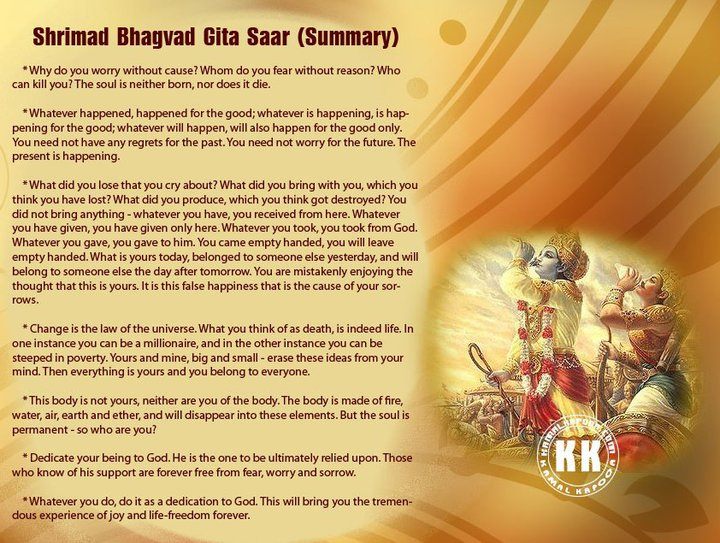
My grandma used to read the Gita to me every day when I was a toddler before I started school. She had a stroke in December and in her final days, I would read verses from the Gita to her returning the favor. Death is the greatest teacher of all, teaches us the value of life and power of decision. Since her passing, I've grown a lot and feel much like Oppenheimer as I work on my 'science project' for the sake of all beings on this planet. It may succeed, it may be ignored. It doesn't matter, I will be dead soon and all that will matter is that I fulfilled my 'dharma'.
Gandhi always kept his copy of the Gita with him and it was his guidebook for his satyagraha movement which led to India's independence.
Some Gita verses that help me, might be helpful to you too:
“It is better to live your own destiny imperfectly than to live an imitation of somebody else's life with perfection.”
“Show good will to all, Be fearless and pure; never waiver in your determination or your dedication to the spiritual life. Give freely. Be self-controlled, sincere, truthful, loving, and full of the desire to serve.
Realize the truth of the scriptures; learn to be detached and to take joy in renunciation. Do not get angry or harm any living creature, but be compassionate and gentle; show good will to all.
Cultivate vigor, patience, will purity; avoid malice and pride Then, Arjuna, you will achieve your divine destiny.”