Which planet happens to be the closest to us right now is the metric most congruent to people's notion of closest and is often important for things like time delays in radio communication. By that metric it's currently Mercury, closely followed by Venus[1]. But it will change and keep changing.
In terms of how hard it is to get places you really want a delt-v map[2]. By that metric Venus is the closest at 640 m/s from Earth intercept to Venus intercept.
It's sort of interesting that, over an indefinite period of time, Mercury is closest on average but that doesn't really correspond to our intuitive notion of "closest" nor is it a particularly useful metric for anything that comes to mind. So the whole gotcha here is really pretty silly.
Basically, the average distance between one planet and another will always be greater than the distance between the respective planet and the sun. (Note that in the table on the last page, all average planet distances for earth are > 1 AU.) Thus whichever planet is closest to the sun will always be the closest on average to any other planet.
This is true for the Solar System because all our planets have near-circular orbits. Suppose though if you had two planets with highly elliptical orbits and similar arguments of perigee. They will spend most of their time far away from their star but relatively close to one another.
I'm not sure if such an elliptical orbit would be possible while still classifying them as planets and not dwarf planets though.
Outside of binary planets orbiting each other, is this achievable as a (mostly) stable configuration?
Intuitively, if the two planets have orbiting periods that are not basically identical, then after long enough they will also have long stretches of time where they are on opposite sides of the star (with a slight caveat if the periods are rational multiples of each other, but in either case their positions will be asymptotically uncorrelated). On the other hand, if they are close and have the same period, I'd expect their gravitational pulls would eventually merge them together unless they become a binary planet system.
But I have no physics/astrophysics background so this could easily all be stupid.
IIRC we've found some big exoplanets in wild orbits. They tend to form in a circular-ish orbit because that's how you get a big enough chunk of the dense bits of an accretion disk, but interactions with other planets/stars can put eg gas giants into wild orbits after formation.
Almost true. Good thinking though.
There are exceptions to this rule, so it's more of a guidance than the actual rule. For example you could have two planets orbiting the Sun at the relatively similar distance from the Sun and a small distance from each other.
Well, that's not the issue here. The issue is two planets can't exist near each other because they can't possibly have formed that way 4.5B years ago and kept existing at that point since then. Their gravitational influences would have long since caused them to collide into each other and form a single planet. There's a reason there's big gaps in the orbital distances of every planet; it's simply not possible to pack them in too tightly.
That's still the same scenario, just slower to become apparent. You need to change other things, like they orbit each other as they go around the Sun, to change this.
It's close equivalent. It's easier to go inwards than outwards in terms of delta-v because orbits further out move more slowly. So if things were a little different the orbit of Mars could have been closer to Earth in terms of distance while Venus would still be closer in terms of delta-v.
Only if you want one-way trip. In case of the two-way trip, Mars could be still closer due to lesser Sun gravity influence that needs to be compensated.
Did you read to the end? The point of the paper is not the gotcha about which planet is really closest. Their point is that their PCM method allows you to quickly estimate distances between groups of planetary bodies in a novel way. They aren't trying to be "gotcha" about it, they're introducing a new model for estimating solar distances.
This exact reasoning is why I've always been kind of annoyed by the song Bitch Don't Kill My Vibe by Kendrick Lamar.
In the chorus he goes "I can feel your energy from two planets away" and even though I know art doesn't have to conform to scientific reality, poetry and music almost especially, it ALWAYS bugged me from the first time I heard it til today.
Like what does 2 planets away even mean? that's a hugely variable distance.
    We're heading for Venus
    And still, we stand tall
    'Cause maybe they've seen us
    And welcome us all, yeah
    With so many lightyears to go
    And things to be found
    I'm sure that we'll all miss her, so

    It’s the final countdown
Someone’s science teacher knows who was too busy writing lyrics in class to learn about outer space…
Haha that's an interesting question. I'm figuring that the closest "2 planets away" would be the canonical distance between Earth and Mercury, ie 57 million miles (92 million km).
But it's the other extreme that's more interesting.
Let's say that for a planet to be the "next" planet over at any given time, it has to be the closest one... by direct line measurement, not by orbit. So for Earth, the next planet over could be at any given time Mercury, Venus or Mars. The most isolated Earth can be from all other planets would be when the planet that is closest to us at a given moment is as far away is it can be. That turns out to be Mercury, whose maximal distance is about 138 million miles away (222 million km). There's always going to be a planet that is that distance to us or closer.
So imagine that Mars happens to be 137 million miles from us while Mercury and Venus are both at least 138 million miles away. That would make Mars the "next" planet over. Then the "next" planet over from Mars could be either Venus or Mercury. If we're assuming Mars is as isolated as possible than the next closest planet besides Earth would be Mercury which at its furtherst could be at most 198 million miles away (319 million km). Thus, ignoring trigonometry which would put a constraint on the Mercury-Mars leg of the triangle, two planets away from us could be at most 336 million miles (540 million km) away.
So between 57 and 336 million miles is your answer.
I always assumed this line uses the traditional order of planets from the sun and referenced the common trope that "Men are from Mars, Women from Venus".
> In terms of how hard it is to get places you really want a delt-v map[2]. By that metric Venus is the closest at 640 m/s from Earth intercept to Venus intercept.
Well, that's also a minimum that changes over time. It might be closest at a particular moment but still not "on average"
> By that metric Venus is the closest at 640 m/s from Earth intercept to Venus intercept
By the way, I think there is a typo on that delta-v map. I doubt low Venus orbit to Venus is 27km/s, vs 9.4 for the earth, when Venus gravity is just 90% that of Earth.
Depends on whether you take atmospheric drag into account. If you do, then you'll be fighting Venus' thick atmosphere all the way up, and that 27km/s figure could well be accurate.
I don't like it when delta-v maps include atmospheric drag, because the numbers depend on how aerodynamic your rocket is, in contrast to the other manoeuvres where the amount of delta-v doesn't depend on the type of rocket you have at all.
The OG image mentions that there are assumptions being made. The image linked by GP is a derivative work, improving on and crediting the work of /u/CuriousMetaphor, however it omits some of the caveats in the legend.
> I don't like it when delta-v maps include atmospheric drag
Yes, I find it quite unintuitive, especially as the map is now asymmetric: if you take into account drag on liftoff, you would also take into account aerobraking for reentry. It means that the map can't really be used for body-to-body calculations, as it assumes "rocket liftoff" for the low orbit<->surface transition.
Ideally, atmospheric parameters should be specified some other way on the map, or it could branch to show both liftoff and reentry costs on each body (and possibly delta-v due only to gravity).
Reentry delta-V isn't really well-posed. The delta V that would enter orbit, or even less, with a somewhat different angle reenters. So the "reentry delta V" might very possibly be negative, in that you could go Earth LEO to body surface with less velocity change.
As other replies are saying, that does include the atmospheric drag. But that number wouldn't actually happen with rocket thrust. You'd never actually do that, launch a rocket from the surface of Venus - you'd first take advantage of the atmosphere to do aerodynamic flight, first carry the rocket to much higher altitude with an airplane and then ignite it from there.
The numbers for reaching LEO include typical atmospheric drag losses. That's only a km/s or so on Earth but on Venus with it's very thick atmosphere the losses are much higher.
You'd certainly need something beyond a chemical rocket but there are options. At that density a turborocket[1] would certainly be worth the extra mass but I think still wouldn't be enough of an advantage. In the realm of roughly existing technology, a nuclear ramjet[2] could get you to the upper reaches of the atmosphere and give you a nice little initial boost as well to your speed. And in the realm of SF, a nuclear saltwater rocket[3] would still be easily capable of making it out of Venus in one stage.
To get a turborocket to work in an atmosphere without oxygen you just have a classic rocket engine, with its own fuel and oxidizer, use its exhaust to drive a turbine the same way a jet is used to drive a turbojet. You have to leave off the afterburner stage that many existing turborockets have where you inject more fuel to burn after the final turbine.
If you're using air for just working mass and not for an oxidizer, it's my belief that this does not improve specific impulse but only improves peak thrust/engine weight.
Because the energy lost to the movement of the propellant goes up as the square of the velocity but the thrust goes up linearly. Bulking out your propellant by a factor of ten while reducing the exhaust velocity by a factor of ten doesn't change the resulting thrust, but reduces the energy you need for that thrust by a factor of 10.
I don’t understand. Two objects are on average closest, but that’s unintuitive because another object is closer based on some astronomical measurement which isn’t distance, which is more intuitive how?
it is interesting that earth spends more time with mercury closer than venus due to orbital mechanics, but the entire premise of the article is just an annoying "gotcha" twist of language.
the planet earth is ever nearest to is Venus, which is what people will mean by "closest neighbor". if you work from home and your next door neighbor works at the office, it doesn't make the retired lady in the next house over your closest neighbor, regardless of spending more time in closer relative proximity to her.
Taking your argument to the extreme, if there was a planet that somehow brushed by extremely closely to Earth every thousand years, that planet would be the closest neighbor? I would argue not. I think the average is more meaningful.
To return to the analogy, if once a year my brother-in-law parks their RV in my drive, nobody would be confused about who my closest neighbour is.
I would argue that MOST people would disagree with you and would say Venus is our closest neighbour but once every 1000 years wobbly Erebus returns from the dark to scare the hell out of us.
The term "neighbor" here is confusing. Venus has the planetary orbits right next to Earth's. That makes them "neighbors" - they live right next door from each other.
Mercury is the closest planet on average, but calling it the closest neighbor is just confusing.
This is exactly my thinking. In this context, I think the paper depends on an implied ambiguity of the word 'neighbor' and how it's used in the context of orbiting bodies.
When I think of 'neighbors' in the context of the solar system, I am generally thinking of neighboring orbits. It would be hard to argue that Venus's orbit is not the closest orbit to Earth's. Or at least it would seem silly to do so.
Maybe I'm being overly pedantic here, but my view is that orbits have neighbors, and planets have orbits, but planets don't necessarily have neighbors. Something in the word 'neighbor' implies persistence to me, so I don't really consider average-closest planet to be a neighbor when exactly which planet is closest to any other changes constantly.
Agreed, that was my initial thought and I was going to comment the exact same thing as you and then I decided to check up the meaning if neighbour. Turned out I've misunderstood the meaning my whole life and it doesn't just mean next to, it means nearby.
If I have a house and you have a house next to me yet neither of us are ever home, we are still neighbors no matter where in the world we are.
Similarly, the entire area earth and Venus clear with their orbits is the planet’s “home”, therefore, we only have two neighbors, Mars and Venus, and Venus is probably the closest.
The average closest planet would be useful for regularly traveling between two places.
The closest at any one time is useful for planning intermittent trips.
Let's say we had to pick 2 equal planets we would travel to. Adding the stipulation that planet A is closer on average to HOME than planet B; Planet B has the shortest distance to HOME.
If travel is cheap then planet A is more useful to travel to since you can afford to do it regularly.
If travel is expensive then planet B is more useful since you can't afford travel all the time and rather need to make sure each trip is worth.
If you live in a city it's more reasonable to go to the grocery every week.
If you live in a rural area it's more reasonable to wait for the Shwan truck (type of grocery delivery) once a month.
“Halley's orbit period is, on average, 76 Earth years. This corresponds to an orbital circumference around the Sun of about 7.6 billion miles (12.2 billion kilometers). The period varies from appearance to appearance because of the gravitational effects of the planets. Measured from one perihelion passage to the next, Halley's period has been as short as 74.42 years (1835-1910) and as long as 79.25 years (451-530).”
“During its 1986 appearance, Halley's nearest approach to Earth occurred on the outbound leg of the trip at a distance of 0.42 AU (39 million miles or 63 million kilometers)“
(The orbit of Venus is at about 0.7 AU, so 0.3 AU from that of earth, so that was further away than Venus can be to earth (https://theskylive.com/how-far-is-venus))
It can get a lot closer, though. From that nasa.gov page:
“The comet's closest approach to Earth occurred in 837, at a distance of 0.033 AU (3.07 million miles or 4.94 million kilometers)”
I had to read their sentence like 5 times to get it as well.
.42AU is a larger distance than the closest that Earth and Venus ever get to each other (i.e. closest than as close as it is possible for Venus to be, with the word "can" being used in this meaning)
I don't think that way. It's more like this: your two blocks down the street neighbor drives by you every morning, would you classify it being closer to you? Because that's how we look at the Venus at the moment. Mercury should be the real neighbor.
I think a better example is neighbour 1 drives past your house once a day and neighbour 2 drives past 10 times a day on the main road several blocks further from your house. If you needed a lift somewhere (or some other reason to interact), you can either wait patiently for N1 to drive past or you can walk the several blocks to the main road, and then wait less time for N2.
If we're talking about transportation, well then. The efficient transfer to Mercury is via Venus transfer, so it is farther by such reckoning. In terms of delta-v budget, Venus is actually closer than Mars, unless you wanted to, say, visit the surface.
So to stretch the analogy to its limits, what if you have someone who lives directly across the freeway from you, and a neighbor whose house is next to the overpass that lets you cross the freeway.
I had never heard of the concept of closest average neigbor before. When I read it, I assumed it meant: draw a straight line between the two bodies, that is the current distance between the two bodies, now average it over a couple of years of motion of these two bodies in space.
I had the same thought: if there was another planet inside mercury's orbit, that would be the mostest closest planet to all the planets, stealing mercury's status, and so you keep iterating on that until you reach smallest and smallest orbits around the sun center of mass (which is inside the sun).
So, if you when you say "the sun" you mean the sun surface, then yes, the sun is always the mostest closest celestial body, to all planets
just because it made it easier for me to reason about the fact that since the sun has some actual width it's exactly equivalent to a body that would orbit at that distance. If you frame it that way then it's rather obvious that the sun also fits the bill as the "mostest closest body" (albeit not planet)
it's not intuitively clear to me whether that is on average closer to the earth or if it's on average exactly as far as something orbiting around that center.
Furthermore, since the sun is also orbiting around the shared center of mass of the whole solar system, this displacement albeit very small, is still enough for me to not intuitively understand if it makes the sun's center of mass closer or farther away on average than the closest orbiting body to the sun
Yes, a hypothetical planet located at the centre of the sun would be every planet's closest neighbour, by virtue of never getting as far away as others.
Nit: located at the gravitational centre of the solar system. Which is not the perfect center of the sun (though still inside it) since all the planets pull on the sun too.
Since that gravitational center, and the center of the pairwise systems is not the same, I wonder if a planet at that place is really the best solution.
> Is the Sun not our neighbor? And it's closer than Mercury, isn't it?
It's not half the time and it is half the time. If you include the Sun as well as one of the possible answers (which I'd argue you shouldn't because neighbour implies same significance, not higher), the answer would've been an even split between Mercury and the Sun (on a large enough time scale).
If Mercury's year somehow lasted longer than a year on another planet, only then would Sun be the clear winner.
Think of it this way: If we take the Earth as stationary and just look at the respective motions of the Sun and Mercury, then the Sun is also (roughly) stationary* and Mercury moves around and around it, sometimes close to us and sometimes far.
Now, if Mercury actually yo-yo'ed through the Sun, then you'd be right: exactly half the time it would be closer to us, and half the time it would be further from us.
But it doesn't yo-yo through the Sun, it moves in a circle. When it's 90º from us and the Sun, it's still further away from us than the Sun is. So it has to get even closer before it's equidistant. So it's actually closer to us only less than half of the time.
*Yes, the Sun would also appear to orbit around the gravitational center of mass, but this doesn't affect the thinking above.
And why is Mercury so hard to get there in terms of energy required? It's because its orbital velocity is so fast and you need to match that. (You can get there without matching the orbital velocity, but that won't be useful, you're either doing a non-capturable flyby or a very hard impact.)
Mercury's orbital velocity is 48 km/s. Earth's is 30. An object at infinity would be zero. Kinetic energy is proportional to velocity squared. Square those numbers and you see the energy differential between Earth's orbit and Mercury's is greater than going from Earth to infinity.
I suppose another very loosely defined notion of closeness is the degree of human habitability, in which sense Mars might be closest. Both Venus and Mercury are incredibly hostile environments, although one could argue for floating cities on Venus and a thin habitable zone at the poles of Mercury.
I understand of course that anywhere "not on Earth" is incredibly hostile to Human life, at least what we can see with present day technology. For truly habitable planets, we might have to consider other star systems and even then there's no guarantee we'll find one.
I don't know to what degree is the abundance of oxygen as a loose element a sign of life, but I'd expect it to be bound to minerals anywhere without significant plant-like life. Perhaps finding another habitable planet is the same task as finding life on another planet?
I appreciated having this pointed out to me - it's fairly clear once the point is made, but I'd never really thought about it. Of course most of the time other planets are over on the other side of the sun and very far away, but it's easy to just picture the school-style orbital map where everything is in a line together and closest approach = closest, period.
I dunno, I thought it was neat! A slight paradigm shift in how I think about the solar system.
SAME! I was waiting for this comment. To me this is result is wonderful! It's like, the physical world behaving in an intuitive, mathematical way once you realize it. I loved reading this.
The way orbits work, orbital velocity is tied to distance. So unless the planets were in the same orbit, one is going to be going faster than the other (the closer one in a radial velocity sense is moving faster, and the further one in a tangential velocity)
Distance: a straight line (i.e. shortest line in Euclidean geometry) between two points - is a one dimensional object/projection.
On Earth crust where we evolved as 1 m long objects immersed in 1 atm of mostly nitrogen at around 290 K and at a constant pull at 1 g on a spinning ball at 11.5 µHz ... you get the idea ... a very straightforward concept.
Applying it to dust and gas particles (massive enough for gravity to shape it into a spinning sphere) in a vacuum falling towards (on a stable enough orbit) a gas ball with 99.8% of the total mass in the system, itself in hydrostatic equilibrium with its own gravity pull through nuclear fusion of hydrogen into helium ... Well, we are not used to that kind of motion i.e. geometry on astronomical scales. But once you see what dictates the (near) stable motions of all those tiny particles the solution is simple: in the solar system the sun is nearest to all objects in the system, on average. Whatever is nearest to the Sun is the closest on average to all other elliptical moving objects. From Neptune's perspective Mercury is barely moving and oscillating so fast as to standing still.
So, in the case of planets the underlying geometry is moving along (stable) elliptical (i.e. closed path) orbits (approx. Newtonian mechanics), applying our "straight" lines for "distance" is amiss here and can lead to confusion. I personally like to see it more - inspired through e.g. Kepler's imagination[0] - as a geometrical-dynamic system (Kepler orbits) more akin to music.
This question came up when I was studying for my PhD, and had access to software with built in solar-centric planetary locations. From what I recall, across the full-range of time available in the software (which was something like 300 years) it did apply that the Mercury-[PLANET] distance was minimal, although possibly not for Pluto since 300 years is only like one-and-a-quarter orbits.
Yes, play of words. And with a choosen weight function.
If, e.g., the weight function would not be ‘sum over all distances in a given timeframe with the same weight’ but for instance ‘… with weight 1/(distance^2), the results would be different (mercury would not win for each planet).
I guess if someone asks, ‘which neighbour’ is closest, I would say the neighbour living literally next door, even though on workdays our distance is much larger (as we work in different cities) then that other neighbour three blocks down who works in the same city as myself.
Similarly, Mount Everest is the highest mountain (above MSL), however Mauna Kea is higher if measured by prominance (starting from its base which is under water).
When saying Mauna Kea starts at the base, why not claim that with Everest?
Of course in reality neither are the highest mountain, that honour goes to Chimborazo, a good 2.1km higher than Everest (when measured from the Earth's centre)
I’m pretty sure the tallest mountain in the solar system is Olympus Mons. Unless you measure it from the Earth’s center, in which case I guess it would be something, anything, on Pluto.
But under what definition of "closet" would it be Venus?
According to CGP Grey's video linked in the comments, not only Mercury has lowest average distance to Earth, it's also spend the most time being the closest planet to Earth, so it already met two definitions I can think of.
You can use delta-v, so the closest is the distance rocket use the least fuel/mass. It is a very good measure how easily to get to that destination in space.
I think you can replace the whole analysis with a single diagram. You don't actually need to find the closed-form solution in terms of elliptic integrals; the only part we use is whether the integrals have a certain monotonicity property (smaller radius => smaller mean distance). And you can rearrange the "mean distance" integrals in way that the rearranged integrands are pointwise monotonic; and the proof that they're monotonic is an elementary geometric one.
The integral over the circle can be rewritten as an integral of a sum of two terms over a semicircle – the term for the local point, plus the term for the mirrored point on the other semicircle. This sum-term is an everywhere-monotonic function of the radius of the circle (in the proof diagram: XA + XB > XC + XD).
(XAQB, XCRD, and XC¹QD¹ are constructed as parallelograms. XC¹RD¹ doesn't mean anything; it's just a construction whose perimeter compares easily against the other two).
Kinda weird argument. The average actual distance of two planets on some orbits can be expected to be roughly equal to the distance of the farther planet from the sun (because the max. distance is r2+r1 and the min. distance is r2-r1, so this type of 'average distance' is ((r2+r1)+(r2-r1))/2 = r2), of course with some variation because the orbits are not truely uniform nor truely random.
The usual notion of comparing the orbit radii is way more intuitive, I think.
> The PCM treats the orbits of two objects as circular, concentric, and coplanar.
Keeping the coplanar assumption, in common with previous estimates, may be a problem. Mercury happens to have an orbital inclination of 7°, second only to Pluto's at 1x7°. Mercury also orbits in an ellipse with an eccentricity of 0.21. Again, this is second only to Pluto, with an orbital eccentricity of 0.25.
I'd like to see a model that takes into account inclination and eccentricity. For the most accurate model, the concentric assumption also fails. Strictly speaking, none of the planets orbit the sun. Rather, the sun and the planet both orbit the barycenter of the sun-planet system, and that will be different for each planet. While the difference is negligible for most planets, for Jupiter the barycenter is quite a distance from the center of the sun: at 1.07 times the diameter of the sun. That's just shy of 100,000km above the surface of the sun.
Let's say my friend was born on January 2, 1900, and I was born on January 1, 1900. Who has the closer birthday to someone born on January 1, 2000?
If you say it's me, well guess what, you're wrong! My birthday is 1 day farther away, just count the days.
If you say it's my friend, well guess what, you're wrong! January 1 == January 1. It's the same birthday, obviously.
Incidentally this is why I think LLMs are a lot more impressive than many here give them credit for. Language is ambiguous and being able to create something novel & coherent using an algorithm is an amazing achievement. Embedded in our use of words is a lot of information that is often incongruent with the understood meaning of the word, as this example shows. Apparently humanity itself has two divergent "hallucinations" of what the word "closest" means in this context. We really can't blame the AI for imitating us when that's what we ask it to do.
Mercury by average. I've wondered in the past it we could land people on Mercury... at the right distance from the sunset terminator where the surroundings had cooled to, say 21 degrees C, (70F). With a 1408 (Earth) hour day, the landing party could stay for quite a while before needing to relocate again towards the terminator, or leave.
Yeah - casually ruling out the moon and sun in the article's first sentence feels a bit underhanded. Beyond pedantry, what's the point of the "Planets Only" sign?
In the commonly understood way, orbitally, Venus definitely is Earth's closest neighbor.
I appreciate pedantry as much as the next person, and it's an interesting article, but this article article and the approach outlined would not aid survival to an interplanetary colonist. They could enjoy being technically correct in the short remainder of their life, while being carbonized. And to follow up pedants, I am well aware of surface conditions on Venus.
Of course it's Mercury but even after I explain it to people and they understand the point, they keep saying that Venus is closest. Probably people are used to think about distance between stationary places so they look at the orbits, not to where planets are on their orbit.
By the way, that probably explains a lot of sci-fi movies where they have to go to Mars first, then Jupiter, then Saturn, then Neptune.
> Probably people are used to think about distance between stationary places so they look at the orbits, not to where planets are on their orbit.
These people are more correct than you give them credit for.
1. If you look at their orbits (and not momentary positions), then the orbit of Venus is closer (less distance) to the orbit of Earth than the orbit of Mercury is.
2. It takes less delta-v to go from Earth to Venus than to Mercury.
Venus has the smallest average distance from each point of the Earth's orbit to the nearest point on the other planet's orbit. I.e. whenever we're shown a diagram of the solar system, the "circle" that is Venus's orbit is closest (has the most similar size) to that of Earth's. I don't know the correct term for this measure.
I think that the trick - that it's not automatic for most people - is "on average". I guess people tend to think about the minimum distance rather than the average.
Is the point of this paper that astronomers should be more careful with their descriptive terminology and avoid using words like neighbor and neighborhood that describe static relationship when those relationships don't apply? If so, that's probably a lesson we can apply more universally.
It’s interesting that Mercury is every planet’s closet neighbor. And of course its orbit is so close to the Sun that that average distance to Mercury is about the same as each planet’s average distance from the Sun. (Which I think is even a closer average neighbor)
We speak a language made for medieval peasants to talk behind their lords' backs, it's hardly surprising that our vocabulary leads to ambiguity when talking about orbital mechanics.
The title should include On Average, but that makes the article less clickable. I wonder if they’ll update the title when Venus whips by later this year.
I find it amusing seeing so many otherwise intelligent people so upset about a fact that contradicts their intuition. It's like when you tell people that if you throw a baseball from the International Space Station toward the Earth, the ball will end up in front of you and behind you at various points in the orbit.
Reminds me of the quote: The universe is under no obligation to make sense to you.
>I find it amusing seeing so many otherwise intelligent people so upset about a fact that contradicts their intuition.
It's not quite that. It's a semantic issue. Colloquially, people think of "the closest planet" as a planet having an orbit closest to that of earth's, whereas the article proposes a different definition of 'average distance' between the planetary bodies. Both definitions are correct, but I argue that the former definition is actually better as it conveys more information about the structure of the solar system, and is more intuitive.
Since you invoked the "universe making sense", I'll explain this using an example created by man:
"The Space Shuttle Orbiter reentered the atmosphere at approximately Mach 25, making it the fastest aircraft ever flown."
The Mach 25 reentry is an empirically verifiable fact. But reasonable people can object to the above assertion on grounds that have nothing to do with that verifiable fact; what exactly constitutes an aircraft and what is the proper way to compare the speeds of aircraft? A reasonable person can assert that speed comparisons between aircraft must be made in level flight, making the shuttle orbiter ineligible for such a record. Some may also object to the characterization of the shuttle orbiter as an aircraft, or the implicit exclusion of other reentry vehicles which were even faster. The universe does not have any objectively correct definition of aircraft, or any objectively correct way to compare aircraft speeds. These are wholly subjective. It has nothing to do with people "wanting the universe to make sense."
Similarly, the universe does not hand us any objectively correct meaning of a planet's "neighbor". Nobody in this thread has disputed any objective empirical facts. The disagreement is solely around the subjective meaning of the ill defined term "neighbor". The disagreement is over pure semantics, not science.
> I find it amusing seeing so many otherwise intelligent people so upset about a fact that contradicts their intuition.
Find a smart person who's never heard of the Monty Hall Problem[1] and tell them the answer without an explanation. They'll want to fist fight you over it. Even after you prove it with math, some won't believe you.
That Mercury is closer than Venus on average is very intuitive: it just never gets very far away from us due to its orbit being so close to the sun. Makes perfect intuitive sense to me.
But this is not a math or intuition problem, it's about ambiguity on what exactly is meant with "closer" – you can have multiple definitions of that: "closest at this particular point in time", "closest at any point in time", "closest on average". None of these are more correct than any other.
>It's like how people don't realize that the sum of 1 and 1 is 0. Many smart people will disagree but it is nonetheless a fact.
No, it isn't a fact. This assertion is a common internet troll trick that relies on misusing the "product property of square roots" [i.e. sqrt(xy) = sqrt(x)sqrt(y)], with the "trick" being that the "product property" is only applicable for x,y >= 0 and x,y ∈ ℝ, and therefore cannot be used to "prove" 1+1=0.
Why purposely mislead people who may take you at your word?
Oh, I'm working in Z_2 with addition defined naturally.
Sort of just a joke, eh? Your definitions can place you in a different place for a different answer. And everyone really does know that. Time-averaged Euclidean vs. Euclidean closest approach vs. rank on the total order definable by orbits' parameters vs. energy needed to reach. So it's a bit pointless to go on about how "the universe doesn't need to make sense" like GGP and be dramatic about it.
The article describes a novel mathematical formula for calculating the average distance between planets orbiting the same star. Using this method (and confirming with computer simulations), the authors determine that Mercury, not Venus, is the closest planet, on average, to Earth.
It’s actually the average closest for all the planets! However it does not really go into the orbital mechanics to offer any intuitive explanation of this surprising result.
The "paper" looks like a science fair project to me (a very good one though!) They don't really come up with a new method of calculating the distance, more like an explanation that might be more intuitive to some.
The average distance is pretty straightforward to calculate over all times using integration.
The paradox is because we use neighbour to mean something else. Imagine 10 RVs doing road trips through SE Asia. Most do extensive tours across multiple countries. One of them stays around a small town the whole time but is on average the closest to any given other van, but never that close to really be called a neighbour but then we call it a “neighbour”


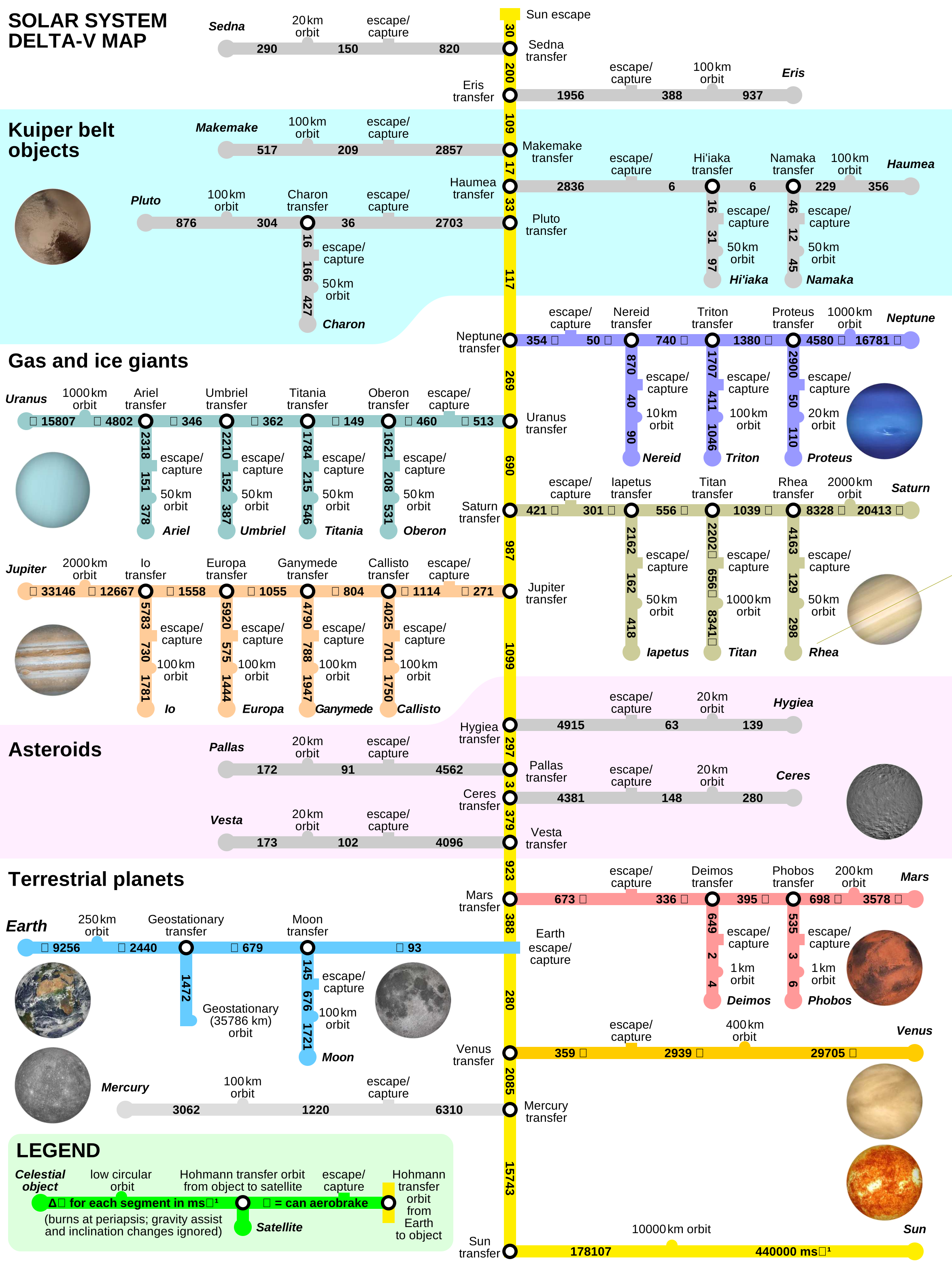

In terms of how hard it is to get places you really want a delt-v map[2]. By that metric Venus is the closest at 640 m/s from Earth intercept to Venus intercept.
It's sort of interesting that, over an indefinite period of time, Mercury is closest on average but that doesn't really correspond to our intuitive notion of "closest" nor is it a particularly useful metric for anything that comes to mind. So the whole gotcha here is really pretty silly.
[1]https://www.theplanetstoday.com/
[2]https://i.imgur.com/AAGJvD1.png