it is interesting that earth spends more time with mercury closer than venus due to orbital mechanics, but the entire premise of the article is just an annoying "gotcha" twist of language.
the planet earth is ever nearest to is Venus, which is what people will mean by "closest neighbor". if you work from home and your next door neighbor works at the office, it doesn't make the retired lady in the next house over your closest neighbor, regardless of spending more time in closer relative proximity to her.
Taking your argument to the extreme, if there was a planet that somehow brushed by extremely closely to Earth every thousand years, that planet would be the closest neighbor? I would argue not. I think the average is more meaningful.
To return to the analogy, if once a year my brother-in-law parks their RV in my drive, nobody would be confused about who my closest neighbour is.
I would argue that MOST people would disagree with you and would say Venus is our closest neighbour but once every 1000 years wobbly Erebus returns from the dark to scare the hell out of us.
The term "neighbor" here is confusing. Venus has the planetary orbits right next to Earth's. That makes them "neighbors" - they live right next door from each other.
Mercury is the closest planet on average, but calling it the closest neighbor is just confusing.
This is exactly my thinking. In this context, I think the paper depends on an implied ambiguity of the word 'neighbor' and how it's used in the context of orbiting bodies.
When I think of 'neighbors' in the context of the solar system, I am generally thinking of neighboring orbits. It would be hard to argue that Venus's orbit is not the closest orbit to Earth's. Or at least it would seem silly to do so.
Maybe I'm being overly pedantic here, but my view is that orbits have neighbors, and planets have orbits, but planets don't necessarily have neighbors. Something in the word 'neighbor' implies persistence to me, so I don't really consider average-closest planet to be a neighbor when exactly which planet is closest to any other changes constantly.
Agreed, that was my initial thought and I was going to comment the exact same thing as you and then I decided to check up the meaning if neighbour. Turned out I've misunderstood the meaning my whole life and it doesn't just mean next to, it means nearby.
If I have a house and you have a house next to me yet neither of us are ever home, we are still neighbors no matter where in the world we are.
Similarly, the entire area earth and Venus clear with their orbits is the planet’s “home”, therefore, we only have two neighbors, Mars and Venus, and Venus is probably the closest.
The average closest planet would be useful for regularly traveling between two places.
The closest at any one time is useful for planning intermittent trips.
Let's say we had to pick 2 equal planets we would travel to. Adding the stipulation that planet A is closer on average to HOME than planet B; Planet B has the shortest distance to HOME.
If travel is cheap then planet A is more useful to travel to since you can afford to do it regularly.
If travel is expensive then planet B is more useful since you can't afford travel all the time and rather need to make sure each trip is worth.
If you live in a city it's more reasonable to go to the grocery every week.
If you live in a rural area it's more reasonable to wait for the Shwan truck (type of grocery delivery) once a month.
“Halley's orbit period is, on average, 76 Earth years. This corresponds to an orbital circumference around the Sun of about 7.6 billion miles (12.2 billion kilometers). The period varies from appearance to appearance because of the gravitational effects of the planets. Measured from one perihelion passage to the next, Halley's period has been as short as 74.42 years (1835-1910) and as long as 79.25 years (451-530).”
“During its 1986 appearance, Halley's nearest approach to Earth occurred on the outbound leg of the trip at a distance of 0.42 AU (39 million miles or 63 million kilometers)“
(The orbit of Venus is at about 0.7 AU, so 0.3 AU from that of earth, so that was further away than Venus can be to earth (https://theskylive.com/how-far-is-venus))
It can get a lot closer, though. From that nasa.gov page:
“The comet's closest approach to Earth occurred in 837, at a distance of 0.033 AU (3.07 million miles or 4.94 million kilometers)”
I had to read their sentence like 5 times to get it as well.
.42AU is a larger distance than the closest that Earth and Venus ever get to each other (i.e. closest than as close as it is possible for Venus to be, with the word "can" being used in this meaning)
I don't think that way. It's more like this: your two blocks down the street neighbor drives by you every morning, would you classify it being closer to you? Because that's how we look at the Venus at the moment. Mercury should be the real neighbor.
I think a better example is neighbour 1 drives past your house once a day and neighbour 2 drives past 10 times a day on the main road several blocks further from your house. If you needed a lift somewhere (or some other reason to interact), you can either wait patiently for N1 to drive past or you can walk the several blocks to the main road, and then wait less time for N2.
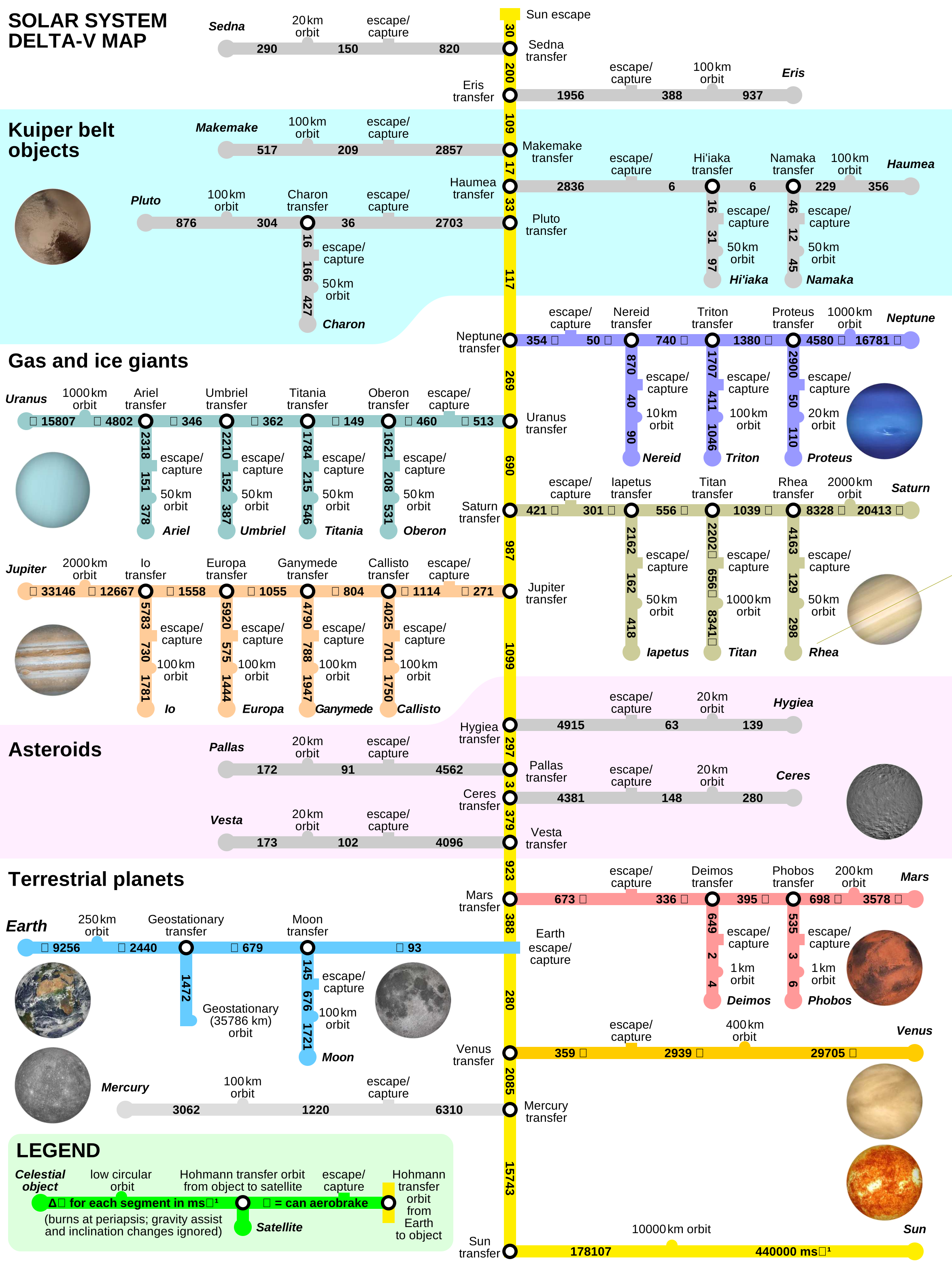
If we're talking about transportation, well then. The efficient transfer to Mercury is via Venus transfer, so it is farther by such reckoning. In terms of delta-v budget, Venus is actually closer than Mars, unless you wanted to, say, visit the surface.
So to stretch the analogy to its limits, what if you have someone who lives directly across the freeway from you, and a neighbor whose house is next to the overpass that lets you cross the freeway.
I had never heard of the concept of closest average neigbor before. When I read it, I assumed it meant: draw a straight line between the two bodies, that is the current distance between the two bodies, now average it over a couple of years of motion of these two bodies in space.


the planet earth is ever nearest to is Venus, which is what people will mean by "closest neighbor". if you work from home and your next door neighbor works at the office, it doesn't make the retired lady in the next house over your closest neighbor, regardless of spending more time in closer relative proximity to her.